
Step-by-Step Guide
Calculate Your Annual Expenses
List every expense you have: fixed monthly costs like rent and insurance, variable costs like groceries and fuel, and irregular annual costs like vacations and medical bills. Multiply your monthly total by 12 and add a 15–20% buffer for expenses you may have missed. This is your baseline annual spend — the most critical number in your FIRE plan. Remember to ask whether your retirement spending will be higher or lower than today; many people underestimate post-retirement healthcare and travel costs.
Run the FIRE Calculator
Open InvestKit's FIRE Calculator and enter your current age, target retirement age, annual expenses, current savings, annual investment amount, expected return (10–12% for equity), and safe withdrawal rate (use 3% for most Indian investors). The calculator will show your FIRE number — the total corpus you need — and your projected FIRE age based on your current savings trajectory. Try different scenarios to see how increasing your SIP or reducing expenses shifts your retirement date.
Bridge the Gap With SIP and Cost Optimization
If your projected FIRE age is later than your target, you have three main levers: increase your monthly SIP using the SIP Goal Planner, reduce your annual expenses to lower your required corpus, or cut investment fees using the Expense Ratio Calculator to switch to lower-cost direct mutual fund plans or index funds. Even a 0.5% reduction in fund fees can add years of additional corpus at retirement. Revisit your FIRE calculator inputs once a year as your income and expenses change.
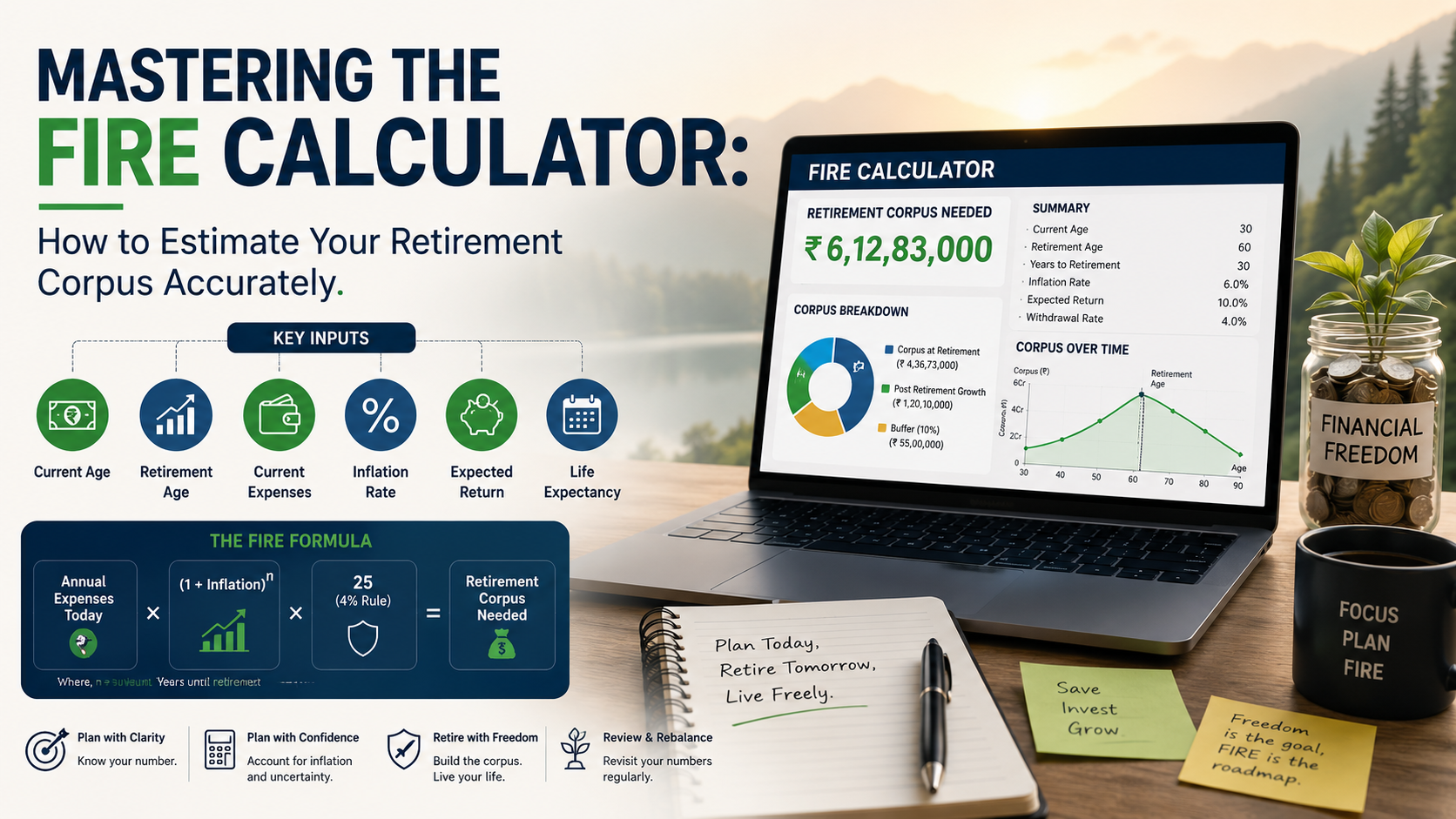
Mastering the FIRE Calculator: How to Estimate Your Retirement Corpus Accurately
Early retirement is no longer just a dream for the ultra-wealthy. With the right numbers, the right savings rate, and a clear plan, financial independence is a goal millions of Indians are actively working toward. But before you can retire early, you need to answer one critical question: how much money is actually enough?
That's exactly what the FIRE movement — Financial Independence, Retire Early — is built around. And in this guide, we'll walk you through how to use the FIRE Calculator on InvestKit to find your personal retirement number, understand the assumptions behind it, and build a realistic plan to get there.
What Is the FIRE Movement — And Is It Right for You?
FIRE stands for Financial Independence, Retire Early. The core idea is simple: save and invest aggressively enough that your investment returns can cover your living expenses indefinitely — without ever needing to work again.
You don't have to retire at 35 to embrace FIRE. For many people in India, the goal is more moderate: retire at 50 instead of 60, or build enough of a financial cushion that work becomes optional rather than mandatory. Even a partial version of FIRE — sometimes called Lean FIRE or Barista FIRE — can dramatically reduce financial stress and give you far more control over your time.
There are several FIRE variants worth knowing:
- Lean FIRE — Retire early on a very minimal budget, cutting lifestyle expenses aggressively.
- Fat FIRE — Retire early with a generous lifestyle, requiring a much larger corpus.
- Barista FIRE — Partially retire; do occasional part-time work to cover small expenses while your investments grow.
- Coast FIRE — Reach a point where your existing investments, left untouched, will grow to your full retirement goal on their own. Use the Coast FIRE Calculator to find this number.
Each path requires a different corpus target, and the FIRE calculator helps you model all of them.
The Core Math Behind FIRE: Your FIRE Number
Before you open the calculator, it helps to understand the formula it's built on. Your FIRE number — the total corpus you need to retire — is calculated using the safe withdrawal rate (SWR):
FIRE Number = Annual Expenses ÷ Safe Withdrawal Rate
For example, if your annual expenses are ₹12 lakh and you use a 4% withdrawal rate:
₹12,00,000 ÷ 0.04 = ₹3,00,00,000 (₹3 crore)
This means if you have ₹3 crore invested, you can withdraw ₹12 lakh per year and — assuming average market returns — your corpus should last indefinitely.
The 4% rule comes from the Trinity Study, which analyzed historical U.S. stock market data. In India, most financial planners recommend using a 3% to 3.5% withdrawal rate instead, because of higher long-term inflation (typically 6–7% vs. 2–3% in the U.S.) and the nature of Indian equity markets. A 3% withdrawal rate for the same ₹12 lakh annual spend gives you a much larger target:
₹12,00,000 ÷ 0.03 = ₹4,00,00,000 (₹4 crore)
This is why choosing the right withdrawal rate in the calculator matters enormously for Indian investors.
Step 1: Calculate Your True Annual Expenses
The single most important input in any FIRE calculation is your annual spending — and most people underestimate it. A rough monthly budget number is not enough. You need to account for everything, including costs that don't appear every month.
Build your annual expense estimate across these categories:
- Fixed monthly costs — rent or home loan EMI, school fees, insurance premiums, utilities, internet, subscriptions
- Variable monthly costs — groceries, fuel, dining out, clothing, household supplies
- Annual or irregular costs — vacations, vehicle maintenance, medical bills, home repairs, family functions
- Future costs to plan for — children's higher education, a child's wedding, aging parent care
Once you have a monthly total, multiply by 12 and then add 15–20% as a buffer for irregular expenses you may have forgotten. This is your baseline annual spend.
Now ask yourself one more important question: will your spending in retirement be higher or lower than today? Many people assume it will be lower (no commuting costs, no work wardrobe), but retirement often brings higher spending on travel, hobbies, and healthcare. Budget honestly — your FIRE number depends on it.
Step 2: Choose Your Withdrawal Rate
As explained above, Indian investors should generally use a 3% to 3.5% safe withdrawal rate rather than the 4% figure commonly cited in Western FIRE content. Here's a practical guide:
| Withdrawal Rate | Best For | Risk Level |
|---|---|---|
| 3.0% | Conservative Indian investors, long retirements (30+ years) | Low — corpus very likely to last |
| 3.5% | Moderate spenders with a flexible budget | Moderate — good historical success rate |
| 4.0% | Shorter retirements, or those with additional income (rent, part-time work) | Higher — based on U.S. data, less suited to Indian inflation |
If you plan to retire at 40 and live until 85, your corpus needs to last 45 years. In that scenario, being conservative with a 3% rate is the safer choice. If you retire at 55 with a paid-off home and rental income covering part of your expenses, 3.5–4% may be perfectly reasonable.
Step 3: Input Your Data Into the FIRE Calculator
Now open InvestKit's FIRE Calculator and enter your numbers. Here's what each field means and how to fill it accurately:
- Current Age — Your age today.
- Target Retirement Age — The age at which you want to stop working. Be honest here; being optimistic by 5 years can make your plan look easier than it is.
- Current Annual Expenses — The number you calculated in Step 1. Enter your current spend, not your future spend — the calculator adjusts for inflation.
- Expected Inflation Rate — Use 6–7% for India. This is crucial; underestimating inflation is one of the most common FIRE planning mistakes.
- Current Savings / Corpus — The total value of all your investments today: mutual funds, stocks, EPF, PPF, NPS, fixed deposits — everything you've accumulated for retirement.
- Annual Savings / Investment — How much you invest toward retirement each year, including SIP contributions, EPF deductions, and lump sum investments.
- Expected Rate of Return — Use 10–12% for an equity-heavy portfolio in India (long-term average for Nifty 50). Use 7–8% for a balanced or conservative portfolio.
- Safe Withdrawal Rate — Use 3% as a starting point for most Indian investors.
The calculator will show you your FIRE number (the total corpus you need) and your projected FIRE age (when you'll get there based on current savings and contributions). Play with the inputs — even small changes to your savings rate or expected return can shift your retirement date by years.
Step 4: Bridge the Gap — What If You're Not on Track?
If the calculator tells you that you'll reach your FIRE number at age 58 but you wanted to retire at 48, you have a gap to close. Here are the most effective levers to pull:
Increase Your Savings Rate
The savings rate is the single most powerful variable in FIRE planning. Going from saving 20% of your income to 40% doesn't just double your savings — it also cuts the time until you reach financial independence dramatically. Use InvestKit's SIP Goal Planner to model how different monthly SIP amounts accelerate your timeline.
Reduce Your Target Expenses
Every rupee you can permanently cut from your annual spend reduces your FIRE number (because it reduces the corpus needed) and simultaneously increases your savings rate. A ₹10,000/month reduction in expenses reduces your FIRE number by ₹40 lakh (at a 3% withdrawal rate) while also adding ₹1.2 lakh per year to your investments.
Optimize Your Investment Returns
High expense ratios silently erode returns over decades. Use the Expense Ratio Calculator to see exactly how much you lose to fund fees over time — and switch to direct mutual fund plans or low-cost index funds where possible.
Add Supplemental Income
Barista FIRE or semi-retirement can significantly reduce your required corpus. If you can earn ₹3–5 lakh per year from part-time consulting, freelancing, or rental income, your FIRE number drops substantially and your retirement date moves much closer.
SIP Planning for FIRE: How to Get There Systematically
Most FIRE journeys in India are funded primarily through SIP (Systematic Investment Plan) contributions into equity mutual funds or index funds. A disciplined SIP in a diversified equity fund over 15–20 years is the most reliable path to building a large retirement corpus for most salaried Indians.
Use these InvestKit tools to build your SIP-based FIRE plan:
- SIP for Retirement Calculator — Find the monthly SIP required to build your specific FIRE corpus by your target retirement age.
- SIP Goal Planner — Model any savings goal with custom return assumptions and time horizons.
- SIP Required for ₹1 Crore — A quick tool to see how long it takes to build your first crore.
Once your SIP is running, revisit your FIRE calculator inputs once a year — as your income grows, increasing your SIP amount in step with your salary is the most effective way to close the gap between your current trajectory and your retirement goal.
Common FIRE Planning Mistakes to Avoid
- Using a 4% withdrawal rate for India. Stick to 3–3.5% given Indian inflation rates. An incorrect withdrawal rate can make your corpus appear adequate when it will run out in 20 years.
- Forgetting healthcare costs. Post-retirement healthcare in India is one of the largest and most unpredictable expenses. Budget generously and consider building a separate health emergency fund alongside your FIRE corpus.
- Not accounting for inflation on expenses. ₹1 lakh per month today will feel like ₹40,000–50,000 per month in purchasing power 20 years from now at 6% inflation. Always use inflation-adjusted figures.
- Ignoring tax on withdrawals. Long-term capital gains from equity mutual funds are taxed at 12.5% above ₹1.25 lakh per year (as of 2024). Factor this into your withdrawal planning so you're not surprised in retirement.
- Not revisiting the plan. Your FIRE number isn't a one-time calculation. Recalculate every year as your expenses, income, and investment returns change.
The Bottom Line
Financial independence is not about luck or a high salary. It's about understanding your numbers, making consistent investment decisions, and using the right tools to stay on track. The FIRE Calculator gives you a clear, honest picture of where you stand and what it will take to get where you want to go.
Start with your current expenses, pick a conservative withdrawal rate, and let the calculator show you your number. Then build a SIP plan around it, keep your investment costs low, and revisit your progress every year.
The math is straightforward. The discipline is the hard part — but knowing your exact target makes it a great deal easier.
Educational Disclaimer
This tutorial is for educational purposes only and should not be considered financial advice. Please consult a certified financial advisor before making investment decisions.