
Step-by-Step Guide
List Your Funds
Gather your investment statements or log into your brokerage account. Write down every ETF and mutual fund you hold, including its ticker symbol, your current allocation, and the benchmark index it tracks. Don't overlook mutual funds or target-date funds — these overlap with ETFs just as easily.
Check for Overlap
Use InvestKit's ETF Overlap Checker to compare every pair of funds in your portfolio. The tool shows your overlap percentage, top overlapping stock positions, and weighted overlap by position size. Any overlap above 50% is worth a closer look; above 70% almost always means you're duplicating exposure unnecessarily.
Optimize Your Holdings
Once you've identified significant overlap, you have three options: consolidate the two funds into one (keeping the lower expense ratio), replace one fund with a complementary holding such as a small-cap or international ETF, or consciously decide to keep the overlap as part of a deliberate strategy. Use the Expense Ratio Calculator to model the long-term cost savings from consolidating.
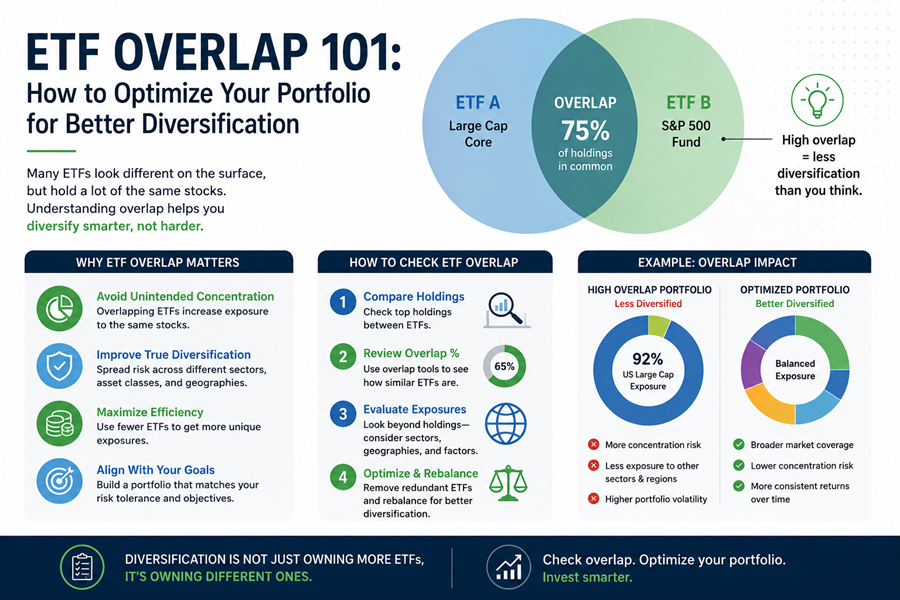
ETF Overlap 101: How to Optimize Your Portfolio for Better Diversification
If you've ever bought three or four ETFs thinking you were building a well-diversified portfolio — only to realize later that all of them hold Apple, Microsoft, and Amazon at the top — you're not alone. This is one of the most common portfolio mistakes individual investors make, and it has a name: ETF overlap.
In this guide, we'll walk you through exactly what ETF overlap is, why it quietly undermines your diversification strategy, how to check it using a free tool, and what to do when you find it. Whether you're a first-time investor or you've been managing your own portfolio for years, understanding overlap is one of the simplest ways to make your investments work smarter.
What Is ETF Overlap — And Why Should You Care?
ETF overlap occurs when two or more exchange-traded funds (or mutual funds) in your portfolio hold many of the same underlying stocks. Because most popular ETFs track broad market indexes — the S&P 500, total market, or large-cap growth benchmarks — their top holdings often look nearly identical.
For example, if you hold both VOO (Vanguard S&P 500 ETF) and QQQ (Invesco Nasdaq-100 ETF), you might think you're diversified across two different strategies. In reality, both funds hold significant positions in the same mega-cap tech companies. The result? You're doubling (or tripling) your exposure to a handful of stocks without realizing it.
This matters for a few key reasons:
1. False sense of diversification. Owning five ETFs doesn't mean you own five different things. If they all overlap by 60–80%, your portfolio is far more concentrated than it looks on paper.
2. Concentrated risk. When the same 10 stocks drive the performance of all your funds, a single sector downturn hits you harder than it should.
3. Unnecessary costs. Every ETF you hold comes with an expense ratio — an annual fee charged as a percentage of your investment. If two funds are essentially identical, you're paying twice for the same exposure. Consolidating can meaningfully reduce your total cost of ownership over time.
How to Check ETF Overlap in Your Portfolio
Checking for overlap manually is tedious — you'd need to pull the full holdings list for each fund and compare them row by row. Fortunately, there's a faster way.
Step 1: List Every ETF and Mutual Fund You Currently Hold
Start by gathering your investment statements or logging into your brokerage account. Write down every fund you own, including:
The ticker symbol (e.g., VTI, SPY, SCHB)
Your current allocation or dollar value in each
The fund's stated investment objective or benchmark index
Don't skip mutual funds — they overlap with ETFs just as easily as ETFs overlap with each other. A target-date fund, for instance, often holds several index funds internally, some of which you may already own separately.
Step 2: Use the ETF Overlap Checker
Once you have your list, use InvestKit's ETF Overlap Checker to compare any two funds side by side. The tool analyzes the underlying holdings of both funds and calculates what percentage of the portfolio is shared between them.
Here's what to look for in the results:
Overlap percentage — the share of holdings that appear in both funds
Top overlapping positions — the specific stocks driving the overlap, usually large-cap names like Apple, Nvidia, or Meta
Weighted overlap — some tools weight by position size, which gives a more accurate picture than a simple count of shared tickers
Run the comparison for every pair of funds in your portfolio. If you hold four ETFs, that's six comparisons. It takes less than five minutes and the insights can be surprisingly eye-opening.
Step 3: Interpret Your Results
Not all overlap is a problem — some is unavoidable and even expected. Here's a rough guide to reading your results:
Overlap LevelWhat It Means0–25%Healthy diversification — the funds complement each other25–50%Moderate overlap — acceptable depending on your strategy50–70%Significant overlap — reconsider whether you need both funds70%+Very high overlap — you are likely paying twice for the same exposure
As a general rule: anything above 50% overlap means the diversification benefit of holding both funds is minimal. You're adding complexity and cost without meaningfully reducing risk.
Step 4: Optimize — What to Do When You Find Overlap
Finding significant overlap doesn't mean you need to panic or make drastic changes. It means you have a clear, actionable opportunity to clean up your portfolio. Here are your main options:
Option A: Consolidate Into One Fund
If two funds have more than 70% overlap, the simplest fix is to sell one and roll the proceeds into the other. For example, if you hold both SPY and IVV — two funds that both track the S&P 500 — there's no reason to own both. Pick the one with the lower expense ratio and consolidate.
This reduces your annual fees, simplifies your portfolio, and makes rebalancing much easier going forward.
Option B: Replace One Fund With a Complementary Holding
If you want to maintain the same overall allocation but reduce overlap, consider replacing one of the overlapping funds with something that offers genuine diversification. For instance:
Swap a second large-cap U.S. fund for a small-cap index ETF (e.g., IWM or VB)
Replace a domestic equity overlap with an international developed markets ETF (e.g., VEA or EFA)
Add sector-specific or factor-based ETFs (value, dividend, or real estate) that move differently from your existing holdings
The goal is to make sure each fund in your portfolio is doing a different job.
Option C: Do Nothing — Intentionally
Sometimes overlap is intentional. If you're overweighting large-cap tech because you believe in that sector's long-term growth, holding two funds with significant tech overlap may be a deliberate strategy, not a mistake. The key word is deliberate. Know what overlap you have, and make a conscious decision to keep it rather than discovering it accidentally during a downturn.
How to Compare Expense Ratios After Consolidating
Once you've identified which funds to keep, use InvestKit's Expense Ratio Calculator to model the long-term cost difference between your current setup and a consolidated portfolio.
Even a 0.10% difference in annual fees might seem trivial, but over a 20- or 30-year investment horizon — with compounding — it can amount to tens of thousands of dollars on a mid-sized portfolio. Cutting unnecessary overlap often means cutting unnecessary costs, and that directly improves your long-term returns without taking on any additional risk.
Common ETF Pairs With High Overlap (What to Watch For)
Here are some commonly held fund combinations that tend to produce significant overlap:
VOO + VTI — Both are Vanguard funds; VOO tracks the S&P 500, while VTI tracks the total U.S. market. VTI includes everything in VOO plus smaller companies, so the overlap in large-caps is very high (typically 80%+).
SPY + IVV — Both track the S&P 500 exactly. Overlap is essentially 100%.
QQQ + XLK — QQQ tracks the Nasdaq-100 and XLK tracks U.S. technology. Heavy overlap in top tech names.
SCHB + VTI — Different providers, same broad-market exposure. Very high overlap.
None of these combinations are inherently bad, but knowing the overlap helps you make informed decisions rather than assuming variety equals diversification.
The Bottom Line
ETF overlap is one of those portfolio problems that's easy to miss and easy to fix once you know it's there. The process is simple: list your funds, run them through an ETF overlap checker, and consolidate or rebalance where the overlap is excessive.
The result is a cleaner, cheaper, and genuinely more diversified portfolio — one where every fund is pulling its own weight and serving a distinct purpose in your overall strategy.
Ready to find out how much of your portfolio is actually the same stocks in disguise? Use InvestKit's free ETF Overlap Checker →
Educational Disclaimer
This tutorial is for educational purposes only and should not be considered financial advice. Please consult a certified financial advisor before making investment decisions.