
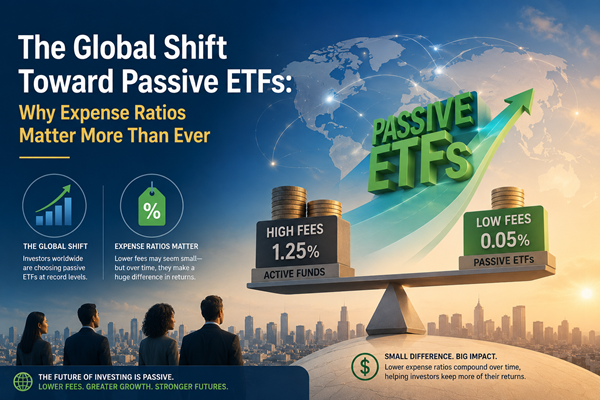
The Global Shift Toward Passive ETFs: Why Expense Ratios Matter More Than Ever
A quiet revolution is happening in the world of finance. Millions of investors are abandoning expensive, actively managed mutual funds for the simplicity and efficiency of Exchange-Traded Funds (ETFs). This global shift toward passive investing is driven by a single, powerful realization: costs matter.
The Rise of the Passive Giant
For decades, the standard advice was to find a 'star' fund manager who could beat the market. However, data from S&P Dow Indices (SPIVA) consistently shows that over long periods, the majority of active managers underperform their benchmark indices. As a result, investors are increasingly choosing to 'be the market' rather than 'beat the market' using ETFs.
What is an ETF?
An ETF is a basket of securities that tracks an underlying index, such as the Nifty 50 or the S&P 500. Unlike traditional mutual funds, ETFs are traded on stock exchanges like individual stocks.
The Expense Ratio Impact: The Silent Wealth Killer
The most significant advantage of ETFs is their low cost. The Expense Ratio represents the annual fee charged by the fund house to manage the investment. While 1% or 1.5% might seem small, the impact over 20-30 years is astronomical due to the 'reverse compounding' of fees.
The Math of Costs
Imagine two investors, A and B, both investing ₹10,000 monthly for 25 years with a 12% gross return.
Investor A (Active Fund): 1.5% Expense Ratio. Final Corpus: ~₹1.35 Crore.
Investor B (Passive ETF): 0.1% Expense Ratio. Final Corpus: ~₹1.82 Crore.
By choosing the low-cost ETF, Investor B ends up with ₹47 Lakhs more for their retirement. This is why using an Expense Ratio Calculator is non-negotiable for serious investors.
How to Check for ETF Overlap
As investors buy multiple ETFs, they often unknowingly buy the same stocks across different funds. For example, both a Nifty 50 ETF and a Technology ETF might hold heavy weights in companies like Infosys or TCS. This 'overlap' reduces diversification and increases risk.
Use our ETF Overlap Checker to ensure your portfolio is truly diversified.
Conclusion
The shift to ETFs isn't just a trend; it's a structural change in the investment industry. By focusing on what you can control—your costs and your diversification—you significantly increase your chances of reaching financial freedom.
FAQs
Q: Are ETFs safer than mutual funds? A: Not necessarily. The risk depends on the underlying assets. An equity ETF carries market risk just like an equity mutual fund.
Q: Can I buy ETFs in India? A: Yes, you can buy ETFs through any stockbroker using your demat account.
Q: What is a good expense ratio for an ETF? A: In India, many Nifty 50 ETFs have expense ratios as low as 0.05% to 0.10%. Anything below 0.20% is considered very low-cost.
Related Tools
Finance Disclaimer
This news article is for educational and informational purposes only. It should not be considered financial advice. Please verify details from official sources and consult a certified financial advisor before making investment decisions.