
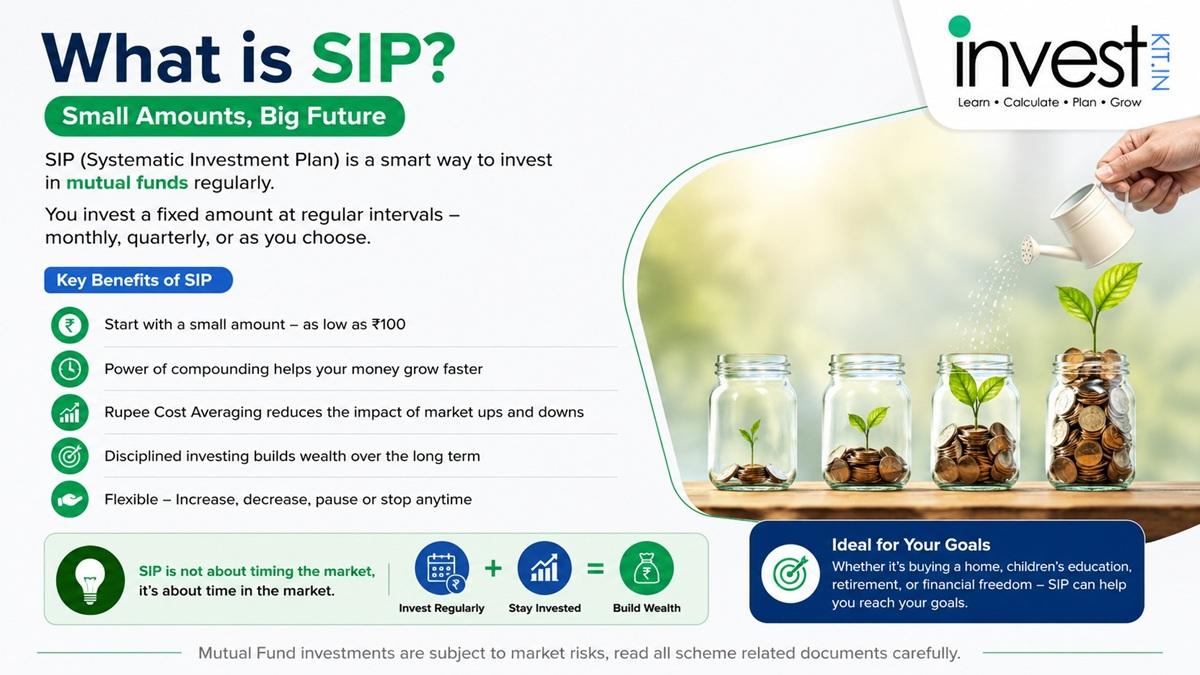
What is SIP? A Beginner's Complete Guide to Systematic Investment Plans
Let's be honest — most of us grew up hearing "save money, put it in the bank" and that was the entire financial education we got. Then one day someone mentions SIP at a dinner table, your cousin swears by it, and suddenly you're wondering: what is SIP exactly, and am I missing out on something? If that's you, you're in the right place. This guide is going to break down SIP — Systematic Investment Plan — from the very basics, in plain English (and a few rupees).
SIP has quietly become one of the most popular investment tools in India. According to AMFI data from April 2026, monthly SIP contributions in India crossed ₹26,000 crore — that's a staggering number, and it represents millions of ordinary Indians choosing to invest rather than just save. And the beautiful part? Most of them started small. ₹500 a month. ₹1,000 a month. That's it.
In this guide, you'll learn exactly what SIP means, how it works under the hood, why it's become the go-to investment strategy for salaried professionals across India, and how you can start one today — even if you've never invested a single rupee before.
What is SIP — The Simple Explanation
SIP, or Systematic Investment Plan, is a method of investing a fixed amount of money into a mutual fund at regular intervals — typically monthly. Think of it like an EMI, but instead of paying for something you already bought, you're building wealth for your future self.
Here's how simple it really is: You decide you want to invest ₹5,000 every month into, say, a Nifty 50 index fund. On the 5th of every month, your bank auto-debits ₹5,000 and buys units of that mutual fund at whatever the current price (NAV) is. You don't have to think about it. You don't have to time the market. You just set it up once and let it run.
The "systematic" in Systematic Investment Plan is the key word. It's disciplined, automatic, and consistent — three things that are genuinely hard to maintain when you're managing investments manually.
SIP Meaning: Breaking Down the Jargon
When people say "I've started a SIP," what they usually mean is: "I've set up a recurring investment into a mutual fund." The SIP itself is just the delivery mechanism — the vehicle. The actual investment happens inside a mutual fund, which then invests your money into stocks, bonds, or a mix of both depending on the fund type.
- NAV (Net Asset Value): The per-unit price of the mutual fund. When you invest ₹5,000 and the NAV is ₹100, you get 50 units.
- Units: Your ownership stake in the fund. The more units you accumulate, the more wealth you're building.
- Folio: Your account with the mutual fund house, identified by a unique number.
- Fund House (AMC): The company that manages the mutual fund — like HDFC AMC, SBI Mutual Fund, Mirae Asset, etc.
How SIP Works — The Mechanics Behind It
Understanding how SIP investment works in India requires understanding two core concepts: rupee cost averaging and the power of compounding. These aren't buzzwords — they're the actual engines behind why SIPs work so well over time.
Rupee Cost Averaging: Your Built-In Safety Net
When you invest a fixed amount every month, the number of units you buy automatically adjusts with the market. When markets are down and the NAV is low, your ₹5,000 buys more units. When markets are up and the NAV is high, your ₹5,000 buys fewer units. Over time, your average cost per unit tends to be lower than the average NAV — and that's rupee cost averaging at work.
Let's say Rahul invests ₹5,000/month for three months:
| Month | Investment | NAV | Units Purchased |
|---|---|---|---|
| January | ₹5,000 | ₹100 | 50 |
| February | ₹5,000 | ₹80 | 62.5 |
| March | ₹5,000 | ₹110 | 45.45 |
| Total | ₹15,000 | Avg: ₹96.67 | 157.95 |
Rahul's average cost per unit is ₹15,000 ÷ 157.95 = ₹94.97 — lower than the average NAV of ₹96.67. That's the magic of rupee cost averaging. You benefit from market dips automatically, without having to "time" anything.
The Power of Compounding: Why Time is Your Best Friend
Albert Einstein reportedly called compound interest the eighth wonder of the world. Whether he actually said it or not, the math is undeniable. In a SIP, your returns generate their own returns over time — and in the long run, this creates dramatic wealth multiplication.
Consider Priya, a 25-year-old software engineer in Bengaluru who starts a SIP of ₹10,000/month. Assuming a 12% annual return (roughly what Nifty 50 has historically delivered over 15+ year periods, though past performance is not guaranteed):
- After 10 years: She would have invested ₹12 lakh — portfolio value approximately ₹23.2 lakh
- After 20 years: She would have invested ₹24 lakh — portfolio value approximately ₹99.9 lakh (nearly ₹1 crore!)
- After 30 years: She would have invested ₹36 lakh — portfolio value approximately ₹3.5 crore
The invested amount grew by 3x. The portfolio grew by nearly 10x. That gap — between what you put in and what you get out — is compounding doing its work quietly over decades. Want to calculate your own numbers? Try our SIP Goal Planner to see what your monthly investment could grow into.
Types of SIP in India
SIP isn't one-size-fits-all. Depending on your income pattern and financial goals, different SIP variants might suit you better.
Regular SIP
The standard version — a fixed amount invested at fixed intervals. Best for salaried individuals with predictable monthly income. Simple, automatic, effective.
Step-Up SIP (Increasing SIP)
You increase your SIP amount by a fixed percentage every year. For example, Vikram starts with ₹5,000/month and steps up by 10% each year. By year 5, he's investing ₹7,320/month. This is great for people whose salaries grow annually — you increase your investment in line with your income growth.
Flexible SIP
Allows you to increase or decrease your SIP amount depending on your cash flow. Useful for freelancers or business owners with variable income — though it requires more manual management.
Trigger SIP
You set specific market conditions (like a trigger NAV or index level) to automatically invest. This is more complex and generally not recommended for beginners — it requires market knowledge and can backfire if not used carefully.
Perpetual SIP
A SIP with no end date. It keeps running until you explicitly stop it. Most financial advisors recommend this approach — let it run, don't tinker.
SIP Investment in India — Who Should Start and When?
In my experience reviewing portfolios of Indian investors ranging from fresh graduates to senior professionals, the single biggest mistake people make is waiting for the "right time" to start a SIP. There is no right time. The best time was yesterday. The second-best time is today.
SIP is ideal for:
- Salaried professionals who want to automate their wealth-building without timing the market
- Young earners (22–30) who have the longest compounding runway ahead of them
- Parents planning for a child's education or marriage 15–20 years away
- Anyone building a retirement corpus — use our SIP for Retirement Calculator to plan your numbers
- First-time investors who are nervous about lump-sum investing in volatile markets
SIP might not be the primary tool for someone who needs liquidity in less than 3 years, or for very short-term goals. For those, debt funds, liquid funds, or FDs may be more appropriate.
How to Start a SIP in India — Step by Step
Starting a SIP in India today is genuinely easy. You don't need a broker, you don't need to visit a branch, and you don't need to invest lakhs. Here's how to do it:
- Complete your KYC: If you haven't done KYC (Know Your Customer), you can complete it online on any AMC website or through platforms like Zerodha Coin, Groww, or Paytm Money using your Aadhaar and PAN.
- Choose the right fund: For most beginners, a broad-market index fund (like a Nifty 50 or Nifty 500 index fund) is an excellent starting point. Low cost, diversified, no fund manager dependency.
- Decide your SIP amount: Start with what you're comfortable with — even ₹500/month counts. You can always step up later.
- Set the SIP date: Pick a date right after your salary credit date — so the money moves before you spend it.
- Set up auto-debit: Register an e-mandate with your bank. Most platforms do this digitally in minutes.
- Don't touch it: Seriously. Resist the urge to pause or stop your SIP when markets fall. That's precisely when you should stay invested.
Common SIP Myths — Busted
Myth 1: "I need a lot of money to start a SIP"
You can start with as little as ₹100/month on some platforms. ₹500/month is the standard minimum for most funds. You don't need to be rich to invest — you invest to become financially secure.
Myth 2: "SIPs are risky because mutual funds invest in stocks"
Risk depends on the type of mutual fund you choose. Equity funds carry market risk, but debt mutual funds and hybrid funds offer lower volatility. And over long periods (10+ years), equity SIPs have historically delivered strong inflation-beating returns.
Myth 3: "You should stop SIPs when markets crash"
This is arguably the worst thing you can do. Market crashes are when your fixed SIP amount buys the most units — you're essentially shopping for investments at a discount. Stopping a SIP during a crash locks in your losses and kills your rupee cost averaging benefit.
Myth 4: "SIP returns are guaranteed"
Absolutely not. SIP is an investment mechanism, not a savings scheme. Returns are market-linked and depend on the underlying fund's performance. Historical returns of equity mutual funds have ranged widely, and past performance does not guarantee future results.
SIP vs Lump Sum — Which One Should You Choose?
If you have a large amount ready to invest, should you put it all in at once (lump sum) or spread it via SIP? The answer depends on your market comfort and timing.
Research consistently shows that for most retail investors who can't predict market movements (which is almost everyone), SIP wins because it removes the stress of timing. Even professional fund managers struggle to time the market consistently — so why should you try?
That said, if you receive a large windfall (like a bonus or maturity of an FD), a STP (Systematic Transfer Plan) — where you park money in a liquid fund and transfer it monthly to an equity fund — is often the best of both worlds.
Conclusion: What is SIP and Why Should You Start Today?
What is SIP, at its core? It's a simple, disciplined, and powerful way to build long-term wealth in India — one month at a time. It removes emotion from investing, automates your savings, harnesses the power of rupee cost averaging, and lets compounding do the heavy lifting over time. Whether you're a 22-year-old fresher in Pune or a 40-year-old professional in Delhi looking to accelerate your retirement corpus, SIP in India has a place in your financial plan.
Start small if you need to. Step up as your income grows. Stay consistent. And give it time — that's the only formula that truly works. Your future self will thank you for every SIP instalment you didn't skip.
Disclaimer: This article is for educational purposes only and does not constitute financial advice. Please consult a SEBI-registered financial advisor before making investment decisions. Mutual fund investments are subject to market risk.
Frequently Asked Questions About SIP
What is the minimum amount to start a SIP in India?
Most mutual funds allow you to start a SIP with as little as ₹500 per month. Some fund houses and platforms like Zerodha Coin and Groww have funds with minimums as low as ₹100/month. There's truly no excuse to wait for a bigger amount.
Is SIP better than FD (Fixed Deposit)?
For long-term goals (5+ years), equity SIPs have historically delivered significantly higher returns than FDs. However, SIP returns are not guaranteed, while FD returns are fixed. The right choice depends on your risk appetite and investment horizon. For a detailed comparison, read our article on SIP vs FD vs PPF.
Can I stop my SIP anytime?
Yes, you can pause or stop your SIP at any time without penalty. You simply need to submit a request to your fund house or platform at least 7–15 days before the next debit date. Your existing units remain invested and continue to grow.
How is SIP taxed in India?
Each SIP instalment is treated as a separate investment for tax purposes. For equity mutual funds, gains from units held for more than 12 months are Long Term Capital Gains (LTCG), taxed at 12.5% above ₹1.25 lakh per year (as of FY2025-26). Short-term gains (held under 12 months) are taxed at 20%. Debt fund gains are taxed as per your income tax slab.
What is the best SIP for a beginner in India?
For most beginners, a passive index fund — like a Nifty 50 index fund or a Nifty 500 index fund — is the safest and most cost-effective starting point. These funds have very low expense ratios (under 0.2%), are fully transparent, and have a strong track record of long-term performance.
Can I have multiple SIPs?
Absolutely. In fact, most seasoned investors have SIPs running across 2–4 different funds to diversify across fund types (large-cap, mid-cap, international). You can run as many SIPs as you like across different fund houses and platforms simultaneously.
Finance Disclaimer
This content is for educational purposes only and should not be considered financial advice. Please consult a certified financial advisor before making investment decisions.