
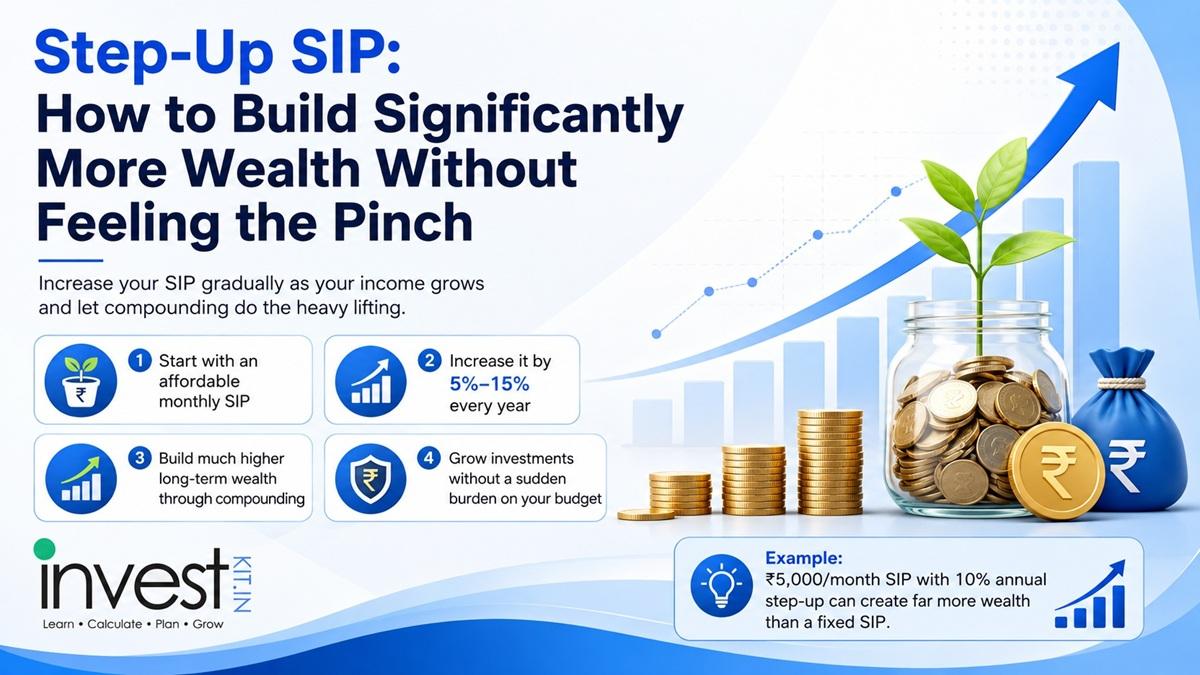
What is a Step-Up SIP?
A Step-Up SIP (also called a Top-Up SIP) is a variant of the regular SIP where your monthly investment automatically increases by a fixed percentage or fixed amount every year. It's designed to align your investments with your growing income — as you get salary raises, your SIP grows proportionally.
Example: You start a ₹10,000/month SIP with a 10% annual step-up. In Year 2, it becomes ₹11,000. Year 3: ₹12,100. Year 5: ₹14,641. Year 10: ₹23,579. By Year 15, you're investing ₹38,697/month — but because the increase happens gradually, it never feels like a sudden financial burden.
The Math: Why Step-Up SIP is So Powerful
Let's compare a flat ₹10,000/month SIP vs a ₹10,000 Step-Up SIP with 10% annual increase, both at 12% annual return, over 15 years:
- Flat SIP: Total invested = ₹18 lakh → Corpus ≈ ₹50 lakh
- Step-Up SIP: Total invested = ₹38 lakh → Corpus ≈ ₹84 lakh
- Difference: ₹34 lakh more corpus
The corpus difference (₹34 lakh) is nearly twice the additional investment made (₹20 lakh extra invested). The rest is pure compounding. This is why Step-Up SIP is one of the most powerful wealth-creation tools available to Indian salaried investors.
How to Implement Step-Up SIP
Most mutual fund platforms support automatic step-up:
- Zerodha Coin: Set step-up amount during SIP creation
- Groww: Top-Up SIP option available
- ET Money: Smart SIP feature with auto step-up
- Kuvera: Step-Up SIP supported
- AMC websites directly: Most major AMCs (SBI, HDFC, ICICI) support step-up SIPs
If your platform doesn't support automatic step-up, you can manually increase your SIP amount every January when your salary revision typically happens.
What Step-Up Percentage Should You Choose?
The most common choices:
- 5% annual step-up: Conservative — suitable if income growth is limited or uncertain. Still creates significantly more wealth than a flat SIP.
- 10% annual step-up: The most popular choice, roughly matching average salary growth in India's organized sector. Recommended as the default.
- 15% annual step-up: Aggressive — suitable for high-income earners in early career stages with rapid salary growth. Creates dramatically higher wealth but requires higher future cash commitment.
A good rule of thumb: set your step-up percentage to match or slightly exceed your expected annual salary increment percentage.
Step-Up SIP vs Lump-Sum Additions
Step-Up SIP is more disciplined than irregular lump-sum additions. When you get a bonus, it's tempting to spend it rather than invest. A pre-committed step-up takes the decision out of your hands — the increased amount is auto-debited, and you adapt your spending to the remaining income.
Behavioral finance research shows that pre-committed, automatic investments consistently outperform discretionary, ad-hoc investing — because they remove the psychological barrier of actively choosing to invest each time.
The Real-Life Impact
Consider Priya, 28, earning ₹8 lakh/year. She starts a ₹10,000/month SIP with 10% annual step-up. By age 43 (15 years), her monthly SIP is ₹41,772 — but her salary has likely grown to ₹25–30 lakh, so the SIP feels proportionally smaller than when she started.
Her corpus at 43: approximately ₹85–90 lakh. If she continues to 50 (22 years), it could reach ₹2.5+ crore. The step-up SIP essentially automates wealth acceleration without requiring any additional financial decisions along the way.
Finance Disclaimer
This content is for educational purposes only and should not be considered financial advice. Please consult a certified financial advisor before making investment decisions.