
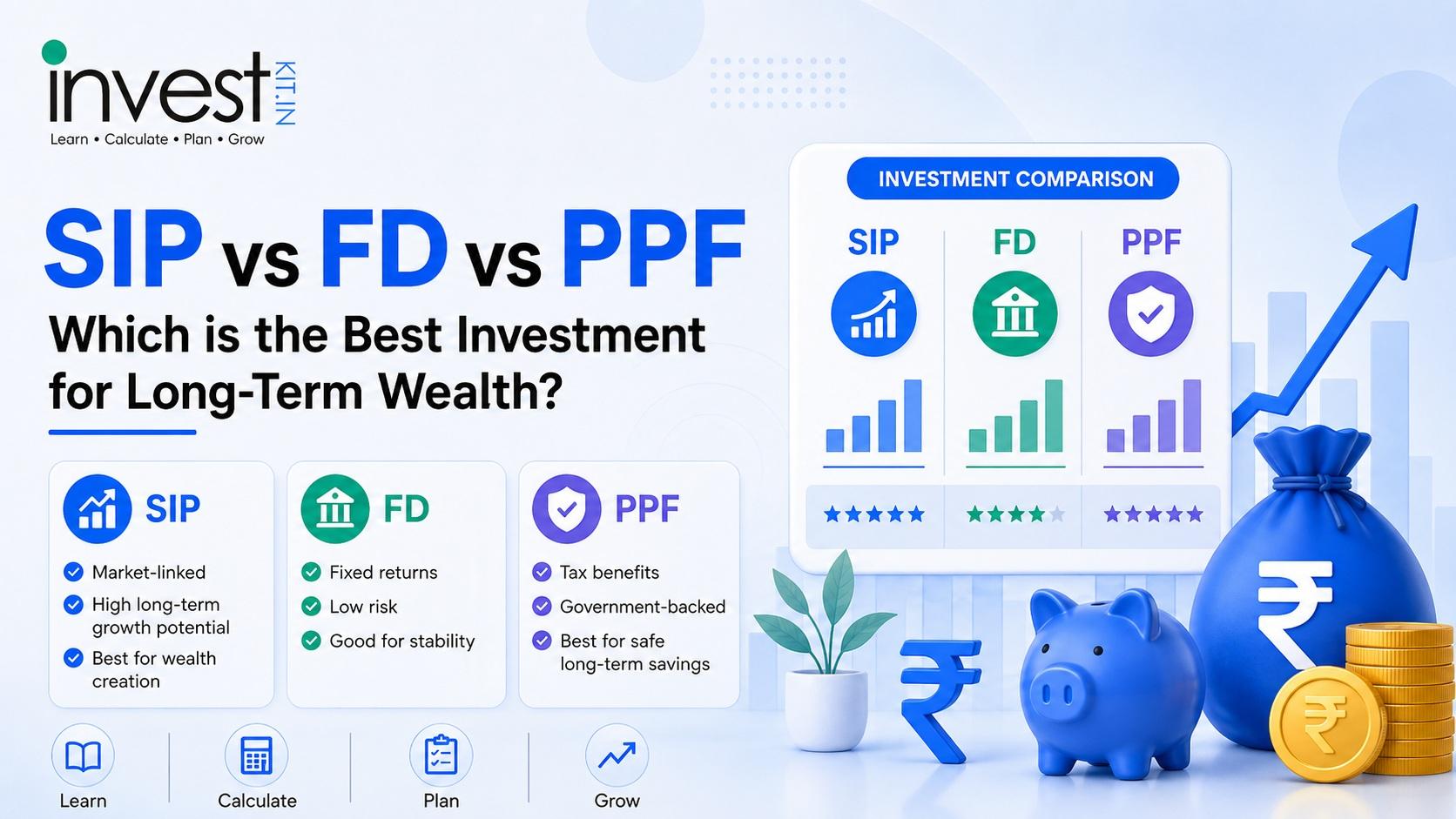
SIP vs FD vs PPF — Which is the Best Investment for Long-Term Wealth?
Here's a scenario that plays out in almost every Indian family: the parents swear by FDs and PPF ("it's safe, guaranteed, no tension"), while the 28-year-old kid keeps hearing about SIPs from colleagues. Everyone's convinced they're right, and nobody has the numbers to prove it. Today, we're going to settle this debate — with data, not opinions.
SIP vs FD vs PPF is one of the most searched investment comparisons in India — and for good reason. Each of these instruments represents a fundamentally different philosophy about money: guaranteed safety vs. market-linked growth vs. tax-privileged compounding. Choosing the wrong one for the wrong goal can cost you lakhs over a decade. Choosing the right one can be the difference between retiring comfortably at 55 and working until 65.
In this guide, we'll compare all three across every dimension that matters — returns, risk, liquidity, taxes, and suitability — using real ₹ figures and real scenarios. By the end, you'll know exactly where your money should go based on your situation, not someone else's opinion.
The Quick Answer: SIP vs FD vs PPF at a Glance
| Parameter | SIP (Equity Mutual Fund) | FD (Fixed Deposit) | PPF (Public Provident Fund) |
|---|---|---|---|
| Expected Returns | 10–14% p.a. (historical, not guaranteed) | 6.5–7.5% p.a. (fixed) | 7.1% p.a. (government-set, quarterly revision) |
| Risk | Market risk (high short-term, low long-term) | Near-zero (bank default risk only) | Sovereign guarantee (zero risk) |
| Liquidity | High (redeem within 1–3 business days) | Medium (penalty on premature withdrawal) | Very low (15-year lock-in, partial withdrawal from year 7) |
| Tax on Returns | 12.5% LTCG above ₹1.25L/year | Taxed as income (up to 30%) | Fully tax-free (EEE status) |
| Minimum Investment | ₹500/month | ₹1,000 typically | ₹500/year (max ₹1.5L/year) |
| Best For | Long-term wealth creation (5+ years) | Short-term goals, emergency reserve | Retirement, tax-saving, guaranteed growth |
Understanding Each Instrument
SIP — Systematic Investment Plan
A SIP is not a product itself — it's a method of investing into a mutual fund at regular intervals. When people say "SIP," they usually mean investing in equity mutual funds via SIP, which gives you exposure to the Indian stock market. The Nifty 50, India's benchmark index, has delivered approximately 12–14% CAGR over 15-year rolling periods historically (source: NSE India data), though this is not a guarantee of future performance.
The key features of SIP investment in India include rupee cost averaging (you buy more units when markets fall, fewer when they rise), the power of long-term compounding, and high liquidity — you can redeem your mutual fund units within 1–3 business days with no penalty (though exit loads may apply in the first year for some funds).
FD — Fixed Deposit
Fixed Deposits are the most traditional investment in India. You park a lump sum for a fixed period (7 days to 10 years) and earn a guaranteed interest rate. As of May 2026, major banks like SBI and HDFC Bank are offering FD rates of 6.5%–7.25% for most tenures, with senior citizens getting an additional 0.25–0.50%.
The biggest appeal of FDs is certainty — you know exactly how much you'll get back. The biggest drawback? Interest is fully taxable as "income from other sources" at your income tax slab rate. For someone in the 30% tax bracket, a 7% FD earns a post-tax return of just ~4.9% — barely above RBI's inflation target of 4%.
PPF — Public Provident Fund
PPF is a government-backed savings scheme with a 15-year lock-in. The current interest rate is 7.1% per annum (as of Q1 FY2026–27, subject to quarterly revision). What makes PPF extraordinary is its EEE (Exempt-Exempt-Exempt) status: your contribution is deductible under Section 80C, the interest earned is tax-free, and the maturity amount is tax-free. For a 30% taxpayer, this can translate to an effective tax-equivalent yield of nearly 10%+.
The primary drawback is the 15-year lock-in. You can extend in 5-year blocks after maturity. Partial withdrawals are allowed from the 7th year onwards, subject to conditions. The contribution limit is ₹1.5 lakh per year — which also caps your upside.
The Numbers Game: SIP vs FD vs PPF Over 15 Years
Let's make this real. Ananya is 30 years old, earns ₹12 LPA, and wants to invest ₹10,000 per month for 15 years toward her retirement. She has three options. Let's see how each plays out:
Scenario 1: ₹10,000/month in SIP (Equity, 12% assumed return)
- Total invested: ₹18,00,000
- Estimated corpus: ~₹50.2 lakh
- LTCG tax (approx.): ~₹3.9 lakh (on gains above ₹1.25L/year)
- Post-tax corpus: ~₹46.3 lakh
Scenario 2: ₹10,000/month in FD (7% p.a., 30% tax bracket)
- Total invested: ₹18,00,000
- Post-tax effective return: ~4.9% p.a.
- Estimated post-tax corpus: ~₹26.6 lakh
Scenario 3: ₹10,000/month in PPF (₹1.2L/year, 7.1% tax-free)
- Total invested: ₹18,00,000
- Estimated corpus: ~₹32.9 lakh (fully tax-free)
Winner by corpus size: SIP — by a significant margin. But the story doesn't end there, because each instrument serves a different purpose.
Want to run your own numbers? Use our SIP Goal Planner to see what your monthly investment could compound into over different time horizons.
When FD is the Right Choice
Let's be fair — FDs absolutely have a place in a smart investor's portfolio. Here's when FD makes sense:
- Emergency fund: Keep 3–6 months of expenses in a liquid FD or savings account. Capital safety matters more than returns here.
- Short-term goals (1–3 years): Planning to buy a car in 2 years? FD is far safer than equity SIP, where markets could be down when you need the money.
- Senior citizens: The additional rate, SCSS (Senior Citizen Savings Scheme) at 8.2%, and capital security make FDs very suitable post-retirement.
- Risk-averse investors: There's no shame in preferring certainty. A guaranteed 7% is better than a theoretical 12% if market volatility keeps you up at night.
When PPF is the Right Choice
PPF shines brightest in these scenarios:
- Tax saving under Section 80C: If you haven't maxed out your ₹1.5L 80C limit, PPF is one of the best options — especially since returns are tax-free unlike ELSS which has LTCG.
- Long-term guaranteed returns: For the ultra-conservative portion of your retirement portfolio, PPF's sovereign guarantee and tax-free status are unbeatable.
- Self-employed individuals without EPF: If you don't have an employer contributing to your PF, PPF is the closest equivalent to a risk-free retirement account.
- Supplementing equity SIP: Many smart investors do both — SIP for growth, PPF for guaranteed tax-free floor. It's not either-or.
When SIP is the Right Choice
SIP outperforms FD and PPF in one critical dimension: long-term wealth creation. For goals that are 7+ years away, equity SIPs have consistently delivered superior inflation-adjusted returns. When should you choose SIP?
- Retirement planning (20–30 years away): The compounding runway is immense. Use our SIP for Retirement Calculator to build your plan.
- Child's education corpus: A 15-year SIP for a newborn's college fund can create a significantly larger corpus than FD or PPF.
- Wealth creation beyond tax-saving limits: Once you've maxed out Section 80C, SIP in equity funds is the most effective way to grow the remaining capital.
- Beating inflation: India's average retail inflation has been 5–6% historically. FDs and PPF barely beat this post-tax. Equity SIPs have delivered 6–8% real returns over long periods.
The Optimal Strategy: Don't Pick One — Combine All Three
Here's the thing: the "SIP vs FD vs PPF" framing is a false choice. The smartest investors don't pick one — they allocate across all three based on purpose:
- Emergency fund (3–6 months expenses) → FD or liquid mutual fund
- Tax saving + guaranteed growth (up to ₹1.5L/year) → PPF (or ELSS SIP for higher risk-return)
- Long-term wealth creation → Equity SIP via index funds
Vikram, a 32-year-old engineer in Hyderabad earning ₹18 LPA, uses exactly this approach: ₹1.5L/year in PPF (tax saving), ₹2L in FD (emergency buffer), and ₹15,000/month SIP in a combination of Nifty 50 index fund and flexi-cap fund. He's not picking sides — he's using each tool for what it's best at.
The Tax Reality Check
Taxes can dramatically change the real returns from each option. For a 30% tax-bracket investor:
| Instrument | Nominal Return | Tax Treatment | Post-Tax Return (approx.) |
|---|---|---|---|
| FD | 7.0% | 30% income tax | ~4.9% |
| PPF | 7.1% | Fully exempt (EEE) | 7.1% (+ 80C deduction benefit) |
| Equity SIP (LTCG) | 12% (assumed) | 12.5% on gains above ₹1.25L/year | ~10.5–11% (depending on holding period) |
The tax efficiency of equity SIPs and PPF vs the fully taxable nature of FDs is one of the strongest arguments for diversifying beyond fixed deposits.
Conclusion: SIP vs FD vs PPF — The Final Verdict
There's no universal winner in the SIP vs FD vs PPF debate — because each instrument solves a different problem. FD is your safety net and short-term tool. PPF is your tax-efficient, guaranteed long-term compounder with a sovereign safety. SIP (equity mutual fund) is your primary engine for long-term wealth creation that beats inflation and builds real purchasing power over decades.
The best investment for long-term wealth creation in India isn't a choice between these three — it's a thoughtful combination of all three, sized based on your goals, time horizon, and risk tolerance. Stop looking for the "best" option. Start building the right mix.
Disclaimer: This article is for educational purposes only and does not constitute financial advice. Return figures used are illustrative and based on historical data. Past performance is not indicative of future results. Please consult a SEBI-registered financial advisor for personalised guidance.
Frequently Asked Questions
Is SIP or FD better for 5 years?
For a 5-year horizon, it depends on your risk appetite. If you cannot afford to lose capital (e.g., saving for a home down payment), FD is safer. If you can stay invested without needing the money urgently and can tolerate short-term market volatility, an equity SIP or balanced hybrid fund SIP could deliver higher post-tax returns over 5 years.
Can I invest in both PPF and SIP at the same time?
Absolutely, and this is actually what most financial planners recommend. PPF and SIP serve different purposes — PPF for tax-free guaranteed growth, SIP for market-linked long-term compounding. Together, they create a balanced long-term portfolio.
Which is better — PPF or mutual fund SIP for tax saving?
Both fall under Section 80C (up to ₹1.5L). PPF offers sovereign-backed guaranteed returns and EEE status. ELSS SIPs (Equity Linked Savings Schemes) have a shorter 3-year lock-in vs PPF's 15 years and offer potential for higher returns, but with market risk. PPF wins on safety; ELSS wins on liquidity and potential return.
What is the SIP return vs FD return over 20 years?
Based on historical data, equity SIP at 12% CAGR would grow ₹10,000/month to approximately ₹99.9 lakh over 20 years. FD at 7% (pre-tax) would grow the same monthly investment to approximately ₹52 lakh — and after 30% tax, the actual take-home is significantly less. The gap widens dramatically with time.
Is PPF safe if the government changes the interest rate?
PPF interest rates are set by the Ministry of Finance and revised quarterly. While rates have come down from the highs of 12% in the 1990s to 7.1% today, the sovereign guarantee on principal and interest remains intact. The government has never defaulted on PPF obligations. Rate risk exists, but default risk is essentially zero.
What happens to my SIP if the market crashes?
A market crash actually works in your favour when you're investing via SIP. Your fixed monthly amount buys more units at lower prices during a crash, lowering your average cost per unit. When the market recovers, your larger unit count multiplies your gains. The worst thing you can do is stop your SIP during a crash.
Finance Disclaimer
This content is for educational purposes only and should not be considered financial advice. Please consult a certified financial advisor before making investment decisions.