
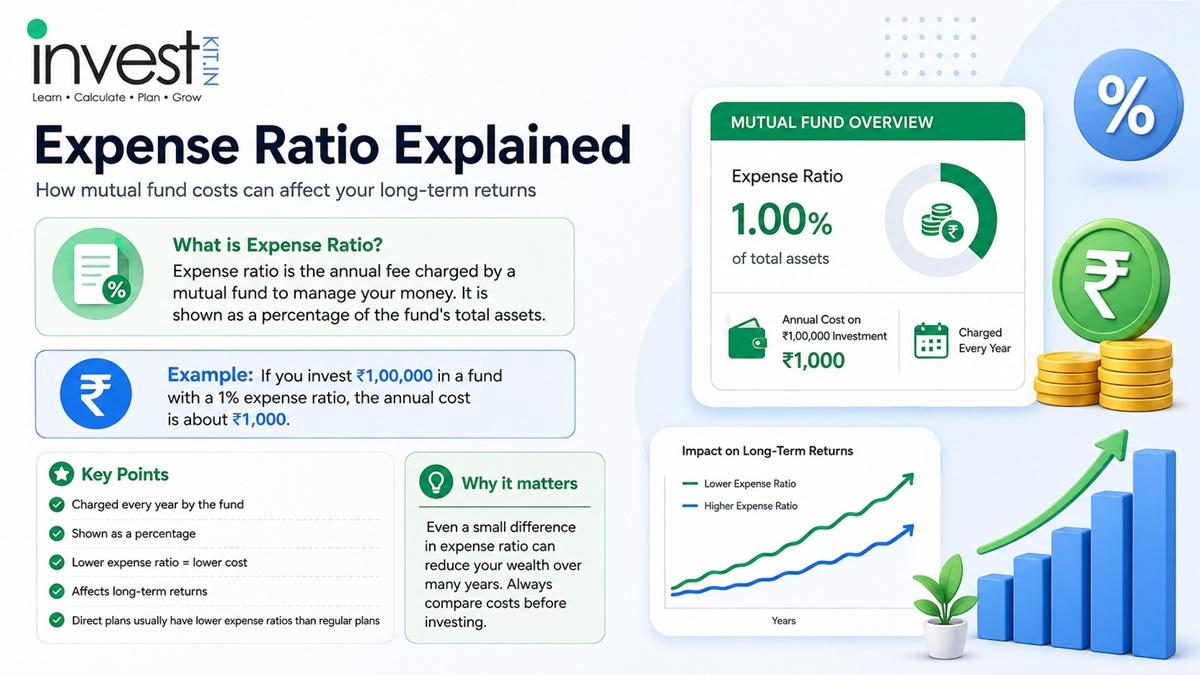
Expense Ratio Explained — How Mutual Fund Fees Are Silently Eroding Your Returns
Imagine you hire two financial advisors. Both manage your ₹10 lakh portfolio for 20 years and earn the exact same 12% gross return. But the first charges you 2% per year in fees, while the second charges just 0.2%. At the end of 20 years, Advisor 1 has grown your money to ₹52 lakh. Advisor 2 has grown it to ₹92 lakh. Same market. Same timeframe. A difference of ₹40 lakh — simply because of fees.
That, in essence, is the power of the expense ratio in mutual fund investing in India. It seems like a small decimal number — 0.5%, 1%, 2% — but over time, the cumulative drag it creates on your wealth is enormous. And the alarming part? Most Indian mutual fund investors have never even heard the term "expense ratio" — let alone checked what their funds are charging them.
In this guide, we're going to explain exactly what expense ratio means, how TER (Total Expense Ratio) works in India, why direct plans can save you lakhs of rupees, and how to check and minimise the fees you're paying right now.
What is Expense Ratio? The Plain Language Explanation
The expense ratio (also called Total Expense Ratio or TER) is the annual fee that a mutual fund charges to cover its operating costs. These costs include:
- Fund manager's salary and team costs
- Research and analysis costs
- Marketing and distribution expenses
- Registrar and transfer agent fees
- Legal, auditing, and compliance costs
- Custodian and trustee fees
This fee is expressed as a percentage of your average daily Assets Under Management (AUM) and is deducted automatically every day from the fund's NAV. You never see a separate invoice — the NAV you see each day is already net of the expense ratio. But just because you don't see it doesn't mean it's not there.
If a fund has an expense ratio of 1.5% and its gross return for the year was 13%, you receive a net return of approximately 11.5%. Simple math — but the long-term compounding impact of that 1.5% drag is anything but simple.
How SEBI Regulates Expense Ratio in India
SEBI (Securities and Exchange Board of India) sets strict limits on how much mutual funds can charge as TER. As of the latest SEBI regulations (effective October 2018, with subsequent updates), the maximum TER slab for equity funds is:
| AUM Slab | Maximum TER (Equity Funds) |
|---|---|
| First ₹500 crore | 2.25% |
| Next ₹250 crore | 2.00% |
| Next ₹1,250 crore | 1.75% |
| Next ₹3,000 crore | 1.60% |
| Next ₹5,000 crore | 1.50% |
| Next ₹40,000 crore | 1.05% to 1.50% (sliding scale) |
| Above ₹50,000 crore | 0.80% |
Index funds and ETFs have much lower limits — typically capping around 1% maximum, and in practice, most index funds charge 0.10%–0.30% today.
You can check the exact TER of any mutual fund on the AMFI website or on the fund house's website. According to AMFI guidelines, all mutual funds must disclose their TER on their websites daily.
Direct Plan vs Regular Plan — The Expense Ratio Difference That Costs You Lakhs
This is the most important thing you can learn from this entire article. Every mutual fund in India exists in two versions:
- Regular Plan: You buy through a broker, distributor, or banking platform. The fund pays the distributor a commission — which is embedded in a higher expense ratio.
- Direct Plan: You buy directly from the fund house or through a direct platform. No distributor commission — so the expense ratio is significantly lower.
The difference in TER between regular and direct plans of the same fund typically ranges from 0.5% to 1.5% per year. That might sound small, but check what it does to your actual returns:
| Plan Type | Gross Return | Expense Ratio | Net Return | ₹10,000/month SIP over 20 years |
|---|---|---|---|---|
| Regular Plan | 12% | 1.5% | 10.5% | ~₹79.3 lakh |
| Direct Plan | 12% | 0.2% | 11.8% | ~₹1.06 crore |
Same fund. Same market. The difference is ₹27 lakh — almost entirely because of expense ratio. That's money that goes into the distributor's pocket instead of yours. Use our Expense Ratio Calculator to see the exact impact on your portfolio.
Active vs Passive Funds — The Expense Ratio Gap
In India, most mutual fund investments are in actively managed funds — where a fund manager researches stocks and makes buy/sell decisions. These funds charge higher TERs (1.0%–2.25% for regular plans, 0.5%–1.5% for direct plans) to pay for the research team and fund manager.
Passive index funds (which simply replicate an index like Nifty 50 or Nifty 500) have dramatically lower TERs — as low as 0.04% for some ETFs, and typically 0.10%–0.30% for direct index funds.
The critical question: do active fund managers justify their higher fees with better performance? The data is sobering. According to SPIVA India Year-End 2024 report, over a 10-year period, approximately 75–80% of actively managed large-cap funds underperformed their benchmark index on a net-return basis. Which means 3 out of 4 large-cap fund managers couldn't beat a simple index fund — after accounting for their fees.
This is why index fund SIPs, with their ultra-low expense ratios, have become the recommended starting point for most Indian investors.
The Hidden Cost of "Small" Expense Ratios — The Compounding Math
Let's look at expense ratio impact over time for Vikram, a 30-year-old who invests ₹20,000/month for 25 years with an assumed gross return of 13% p.a.:
| Expense Ratio | Net Return | Corpus at 25 years | Wealth "Lost" to Fees |
|---|---|---|---|
| 0.1% (Index Fund Direct) | 12.9% | ~₹4.78 crore | — |
| 0.8% (Active Direct) | 12.2% | ~₹4.34 crore | ~₹44 lakh |
| 1.5% (Active Regular) | 11.5% | ~₹3.93 crore | ~₹85 lakh |
| 2.0% (Active Regular, Small Fund) | 11.0% | ~₹3.67 crore | ~₹1.11 crore |
Vikram could leave over ₹1 crore on the table simply by investing in a high-expense regular plan vs. a low-cost index fund direct plan. Over a long investment horizon, expense ratio is not a minor footnote — it's one of the most critical variables in your wealth equation.
How to Find the Expense Ratio of Your Mutual Fund
Checking your fund's TER is simple:
- AMFI Website: Visit amfiindia.com → NAV History → Select your fund → TER is displayed
- Fund House Website: Every AMC displays current TER on the fund's fact sheet page
- Value Research / MorningStar: Third-party fund research platforms display TER prominently on each fund's page
- Your Statement: NSDL or CDSL CAS (Consolidated Account Statement) will show you the plan type (Direct/Regular)
A quick audit: go to your portfolio right now and check if your funds are in the "Direct" or "Regular" plan. If they're Regular, you could be paying significantly more than necessary.
How to Minimise Expense Ratio on Your Mutual Fund Portfolio
1. Switch to Direct Plans
The most impactful step is switching from regular to direct plans. You can do this by:
- Redeeming from the regular plan and reinvesting in the direct plan (note: this may trigger capital gains tax, so plan carefully)
- Using direct platforms like Zerodha Coin, Groww (direct), Kuvera, or the fund house's own website to invest new money only in direct plans
2. Prefer Index Funds for Core Portfolio
For your core long-term equity allocation, consider passive index funds over actively managed funds. A Nifty 50 index fund with 0.15% TER vs. an active large-cap fund at 1.2% TER — if the active fund doesn't consistently beat the index (and most don't), the lower-cost passive option wins.
3. Compare TERs Before Investing
Before starting any new SIP, compare the TER of similar funds. Within the same category (say, flexi-cap funds), TERs can vary significantly. A fund with 0.7% direct TER and another with 1.2% direct TER in the same category — if performance is similar, the lower-cost fund wins over the long run.
4. Review Annually
SEBI requires fund houses to update TER regularly, and TERs can change over time. Do an annual portfolio review to ensure you're still in the most cost-efficient versions of your funds. Use our Expense Ratio Calculator to quantify what you're paying each year.
A Note on Exit Loads vs Expense Ratio
People often confuse expense ratio with exit load. They're different:
- Expense Ratio (TER): Ongoing annual fee, deducted daily from NAV. Unavoidable.
- Exit Load: A one-time fee charged when you redeem units within a specified period (typically 1% if redeemed within 1 year for equity funds). This is avoidable by holding long enough.
Both reduce your returns, but expense ratio is the more significant long-term drag because it compounds every single year for as long as you hold the fund.
Conclusion: Expense Ratio is the One Cost You Can Actually Control
You can't control which way the market moves. You can't control inflation or interest rates. But you can absolutely control the expense ratio on your mutual fund investments in India — and over a 20–30 year horizon, that control could be worth tens of lakhs of rupees.
The single most actionable takeaway from this article: check whether your mutual fund investments are in Direct or Regular plans. If they're Regular, understand the cost you're paying, and evaluate whether switching makes sense for your situation (considering tax implications). And for new investments, always default to Direct plans with the lowest possible TER for your chosen fund category.
Your returns are determined by the market. Your wealth is determined by what you keep after fees. Make every basis point count.
Disclaimer: This article is for educational purposes only and does not constitute financial advice. Return projections are illustrative and based on assumed gross returns; actual returns will vary. Consult a SEBI-registered financial advisor before making investment decisions.
Frequently Asked Questions About Expense Ratio
What is a good expense ratio for a mutual fund in India?
For index funds (passive), a good TER is 0.10%–0.30% for direct plans. For actively managed equity funds, a TER below 1% in direct plans is reasonable. Anything above 1.5% in a direct plan deserves scrutiny — make sure the fund's performance justifies the higher cost. Regular plan TERs of 1.5%–2.5% are almost always too high for most investors.
Is a lower expense ratio always better?
Generally, yes — but not in isolation. A fund with a 0.5% TER that consistently underperforms its benchmark gives you less value than a fund with a 0.8% TER that consistently beats it after all costs. However, given that most actively managed funds don't consistently beat their benchmarks, lower TER is a very strong signal of long-term value in most categories.
How is expense ratio deducted — do I receive a bill?
No, you never receive a separate bill. The expense ratio is deducted daily from the fund's Net Asset Value (NAV). The NAV you see published each evening is already net of the expense ratio. The deduction happens automatically and invisibly — which is exactly why most investors don't notice it.
Can I negotiate the expense ratio with my mutual fund?
No, individual investors cannot negotiate TER. It's set by the fund house within SEBI's prescribed limits and applies equally to all investors in that plan. The only way to pay less is to choose a fund with a lower TER or switch to direct plans.
Does expense ratio affect SIP returns significantly?
Dramatically, yes. A 1% annual difference in expense ratio over 20 years can reduce your final corpus by 15–25% depending on the return assumptions. On a ₹10,000/month SIP over 20 years at 12% gross, a 1% higher TER costs you approximately ₹20–25 lakh in final corpus value.
Are ETFs cheaper than index mutual funds in India?
Typically, yes. ETFs (Exchange Traded Funds) often have slightly lower TERs than index mutual funds — some Nifty 50 ETFs charge as low as 0.03–0.05%. However, ETFs have other costs: brokerage on each transaction, potential bid-ask spread, and demat account charges. For SIP investors, index mutual funds (direct plans) are often more practical despite marginally higher TER, because they allow automatic investment without brokerage costs.
Finance Disclaimer
This content is for educational purposes only and should not be considered financial advice. Please consult a certified financial advisor before making investment decisions.