
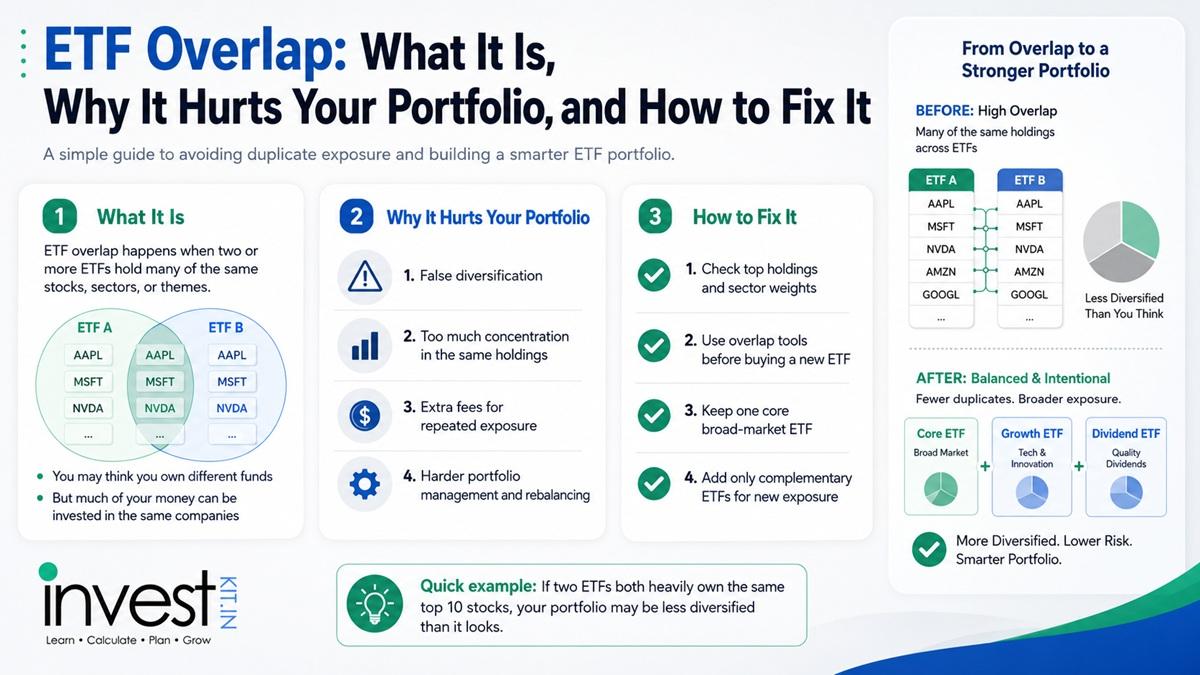
ETF Overlap: What It Is, Why It Hurts Your Portfolio, and How to Fix It
Imagine you walk into a store and buy the same shirt three times — in three different bags. You feel like you've added variety to your wardrobe. But when you open the bags at home, they're identical. That's exactly what happens when you hold multiple ETFs with high overlap.
ETF overlap is one of the most common — and most invisible — problems in modern investing. Whether you're a US investor holding SPY, QQQ, and VGT, or an Indian investor with Nifty 50, Nifty Next 50, and a Flexi Cap fund, the same trap exists: you think you're diversified, but you're actually doubling (or tripling) down on the same stocks.
In this guide, we'll break down what ETF overlap really means, show you real examples from both the US and Indian markets, explain why it's dangerous, and — most importantly — show you exactly how to check and fix it.
What Is ETF Overlap?
ETF overlap happens when two or more funds in your portfolio hold the same underlying stocks. Since most ETFs track broad indices, this happens far more often than investors expect.
Think about it this way: if Apple is the top holding in VOO (S&P 500), QQQ (Nasdaq-100), VUG (Vanguard Growth ETF), and XLK (Technology ETF), and you own all four — your actual Apple exposure could easily be 15–20% of your total portfolio, even though it "looks like" you own four different funds.
The fund names are different. The expense ratios are different. But the underlying stocks? Nearly identical.
Why ETF Overlap Matters — Real Numbers
This isn't a theoretical problem. Here are real overlap examples that affect millions of investors right now:
US ETF Overlap Examples
VOO + VTI: Around 80%+ overlap. VOO tracks the S&P 500 (500 largest US stocks). VTI tracks the total US market (~4,000 stocks). But the largest 500 stocks in VTI are the same as VOO, and they dominate the weighting. Owning both is nearly identical to owning one.
QQQ + XLK: Around 55% overlap. A 2026 analysis found they shared Apple (~10%), Microsoft (~9%), NVIDIA (~3%), Adobe (~2%), and Cisco (~2%) as major common holdings. If you own both expecting tech diversification, you're just concentrating in mega-cap tech.
SPY + VOO + IVV: Nearly 100% overlap. All three track the S&P 500. Holding all three means you're literally paying three separate expense ratios for the exact same portfolio.
Indian ETF and Mutual Fund Overlap Examples
Nifty 50 Index Fund + Nifty Next 50 Index Fund: These two cover different segments but share similar macro exposure — both heavily weighted toward financials (HDFC Bank, ICICI Bank, Reliance). Many investors hold both thinking they're diversified but their sectoral exposure is nearly identical.
Flexi Cap Fund + Large Cap Fund: Most Flexi Cap funds hold 60–70% in large caps. If you also hold a separate Large Cap fund, you're doubling up on the same top 50 stocks from both sides.
Multiple Nifty 50 index funds from different AMCs (e.g., SBI Nifty 50, Nippon Nifty 50, HDFC Nifty 50): 100% overlap — same index, same stocks, just different fund houses. Many investors hold 2–3 of these thinking they're spreading risk.
The 3 Ways ETF Overlap Actually Hurts You
1. You're Not as Diversified as You Think
Diversification is the only free lunch in investing — it reduces risk without reducing expected returns. But it only works when your assets move differently from each other. When your ETFs heavily overlap, they move in lockstep. The 2022 tech selloff exposed this clearly: investors who held a broad market fund, a growth fund, and a tech sector fund thought they were diversified across three funds. All three crashed together because all three were essentially holding the same mega-cap tech names.
A portfolio with 60% overlap between its two core funds has a Sharpe ratio that can drop significantly compared to a truly diversified portfolio — meaning you're taking more risk for the same (or lower) return.
2. You're Paying Double (or Triple) Fees for the Same Stocks
Every ETF charges an expense ratio. When two of your funds hold the same stocks, you're paying two separate fees for the same exposure. Over 20–30 years, even a 0.1% difference in annual cost compounds into lakhs of rupees or thousands of dollars in lost wealth. Overlapping ETFs mean you're leaking returns from multiple directions for zero additional diversification benefit.
3. You Have Hidden Concentration Risk
If Apple makes up 7% of three different ETFs you hold, your real Apple exposure could be 15–20% of your portfolio — even though no single fund shows that number. This kind of hidden concentration is dangerous because a single company's bad earnings, regulatory fine, or sector rotation can hurt your entire portfolio, not just one fund.
For Indian investors, the equivalent risk is in financials. HDFC Bank, ICICI Bank, and Reliance Industries appear in almost every large-cap and index fund. If you hold five large-cap-heavy funds, your exposure to these three names could be enormous — without you realising it.
How to Check ETF and Mutual Fund Overlap (Step by Step)
Checking overlap doesn't require a finance degree. Here's a simple process:
Step 1: List Every Fund You Hold
Write down every ETF or mutual fund in your portfolio. Include index funds, actively managed funds, and sector funds. Don't forget funds held across different accounts — your 401(k), Roth IRA, or Indian Demat account.
Step 2: Look at the Top 10 Holdings of Each Fund
Every ETF and mutual fund is required to disclose its holdings. You can find them on the fund's website, Morningstar, AMFI (for Indian funds), or ETF.com (for US ETFs). Write down the top 10 holdings of each fund you own.
Step 3: Count the Duplicates
Now compare the lists. How many stocks appear in two or more of your funds? If 5 out of the top 10 holdings appear across two funds, you likely have 40–60% overlap between them. That's a serious red flag.
Step 4: Use a Portfolio Overlap Tool
Doing this manually across 5–10 funds gets complicated fast. That's where an automated tool saves hours of work — and catches overlaps you'd easily miss by eye.
Use the InvestKit Portfolio Overlap Tool to instantly check the overlap between your mutual funds and ETFs. It shows you exactly which stocks are duplicated, the percentage of overlap, and which funds to consolidate — all in one place, free.
What Is an Acceptable Overlap Percentage?
Not all overlap is bad. Here's a simple guide:
0–20% overlap: Healthy. Your funds are genuinely covering different parts of the market. No action needed.
20–40% overlap: Moderate. Worth monitoring, especially if both funds are core holdings. Consider whether both are truly necessary.
40–60% overlap: High. You're paying two expense ratios for significantly overlapping exposure. Review whether one fund can be replaced or consolidated.
60%+ overlap: Very high. You're essentially holding the same portfolio twice. One of the funds should almost certainly be replaced or removed. You're diluting diversification and wasting fees.
A good rule of thumb: aim to keep overlap below 30% between any two core holdings in your portfolio.
How to Fix ETF Overlap in Your Portfolio
Once you know where the overlap is, fixing it is straightforward. Here are your options:
Option 1: Consolidate — Remove the Duplicate Fund
If two funds overlap by 70%+, the simplest fix is to sell one and keep the other. Pick the one with the lower expense ratio, better long-term track record, or the one that better matches your overall portfolio strategy.
Example: If you hold both VOO and SPY, just keep VOO (slightly lower expense ratio). If you hold both an SBI Nifty 50 fund and an HDFC Nifty 50 fund — pick one and exit the other. You lose nothing except the duplication.
Option 2: Replace With a Complementary Fund
Instead of removing a fund entirely, swap one of the overlapping funds for something that genuinely adds diversification.
US investors: Replace a second S&P 500 fund with an international developed market ETF (VEA), an emerging markets ETF (VWO or IEMG), a small-cap fund (VB), or a bond fund (BND/AGG). These move differently from your large-cap US exposure and add real diversification.
Indian investors: Replace a second large-cap fund with a true mid-cap or small-cap fund, an international fund-of-funds, or a debt fund for stability. Nifty Midcap 150 or a multi-asset fund will add genuine diversification that another Nifty 50 variant cannot.
Option 3: Simplify to a Single Core Fund
Sometimes the best fix is radical simplification. Instead of holding 5–6 overlapping funds, build around one or two high-quality broad-market funds and add targeted satellite funds only for areas they don't cover.
For US investors: VT (Vanguard Total World) covers US and international in one fund. For Indian investors: a single Nifty 500 index fund covers large, mid, and small caps in one product.
Special Case: ETF Overlap for India-US Global Investors
If you're an Indian investor who also invests in US markets (via international fund-of-funds or platforms like INDmoney), ETF overlap works across borders too.
Many international fund-of-funds sold in India invest in US-listed ETFs like QQQ or S&P 500 funds. If you also hold Indian index funds, your combined portfolio may be globally diversified — but within each geography, you could still have significant overlap between your US holdings and your Indian holdings at the sector level (both markets are heavily weighted toward financials and technology).
The solution is the same: check the top holdings across all your funds, including international ones, and use the Portfolio Overlap Tool to spot the concentration.
ETF Overlap vs. Mutual Fund Overlap — Is There a Difference?
The mechanics are identical — both ETFs and mutual funds can hold the same underlying stocks, creating the same duplication problem. The main practical difference is:
ETFs are more transparent — holdings are disclosed daily, making overlap easier to check in real-time.
Actively managed mutual funds disclose holdings monthly or quarterly, so the overlap picture changes over time as fund managers buy and sell.
Index funds (ETF or mutual fund form) are the most predictable — if two funds track similar indices, their overlap is stable and easy to calculate.
For Indian investors, most SIP-based investments are in actively managed mutual funds. Use the InvestKit Portfolio Overlap Tool to check overlap across your specific fund holdings — it's built for Indian mutual funds and covers major AMCs including SBI, HDFC, ICICI Prudential, Nippon, Axis, and Mirae Asset.
Quick Checklist: Is Your Portfolio Over-Overlapping?
Do you hold more than one fund tracking the same index (e.g., two Nifty 50 funds, or VOO + SPY)?
Do you hold a broad market fund AND a large-cap fund?
Do you hold a tech/growth ETF AND a Nasdaq/S&P 500 fund?
Are your top 3 holdings (HDFC Bank / Apple / Microsoft) appearing in more than two of your funds?
Have you ever added a new fund without checking how it fits with what you already own?
If you answered yes to two or more of the above, it's time to run an overlap check. Use our free Portfolio Overlap Tool — it takes under two minutes and shows you exactly where the duplication is hiding.
Conclusion: Diversification Only Works When It's Real
More funds does not mean more diversification. ETF overlap is the silent portfolio killer — it concentrates your risk, inflates your costs, and gives you a false sense of security. The good news is it's one of the easiest problems to fix once you can see it.
Start by checking your current holdings with the InvestKit Portfolio Overlap Tool. Then consolidate, replace, or simplify based on what you find. A portfolio of three truly different funds will almost always outperform a portfolio of eight overlapping ones — with lower fees and lower hidden risk.
Real diversification means owning assets that move differently. Make sure yours actually do.
FAQs
Q: How do I check if my ETFs overlap?
A: Look at the top 10 holdings of each ETF and count how many stocks appear in more than one fund. Or use the InvestKit Portfolio Overlap Tool for an instant, automatic analysis.
Q: Is 30% ETF overlap too much?
A: 30% overlap between two funds is generally acceptable, especially if one is a core broad-market fund. Above 40–50%, you're paying extra fees for minimal diversification benefit and should consider consolidating.
Q: Can Indian mutual funds overlap with US ETFs?
A: Yes. International fund-of-funds held by Indian investors often invest in US ETFs. Your combined portfolio can have significant sector overlap (especially in technology and financials) across both geographies.
Q: What is the most common ETF overlap mistake?
A: Holding an S&P 500 fund alongside a Nasdaq-100 or growth ETF. These share 34–55% of holdings and give heavily overlapping exposure to mega-cap US tech stocks.
Q: Do index funds overlap more than active funds?
A: Index funds tracking similar benchmarks have very predictable, high overlap (e.g., two Nifty 50 funds = 100% overlap). Actively managed funds can also overlap heavily if managers favour the same large-cap stocks, but this is harder to track in real-time.
Related Tools
Finance Disclaimer
This content is for educational purposes only and should not be considered financial advice. Please consult a certified financial advisor before making investment decisions.