
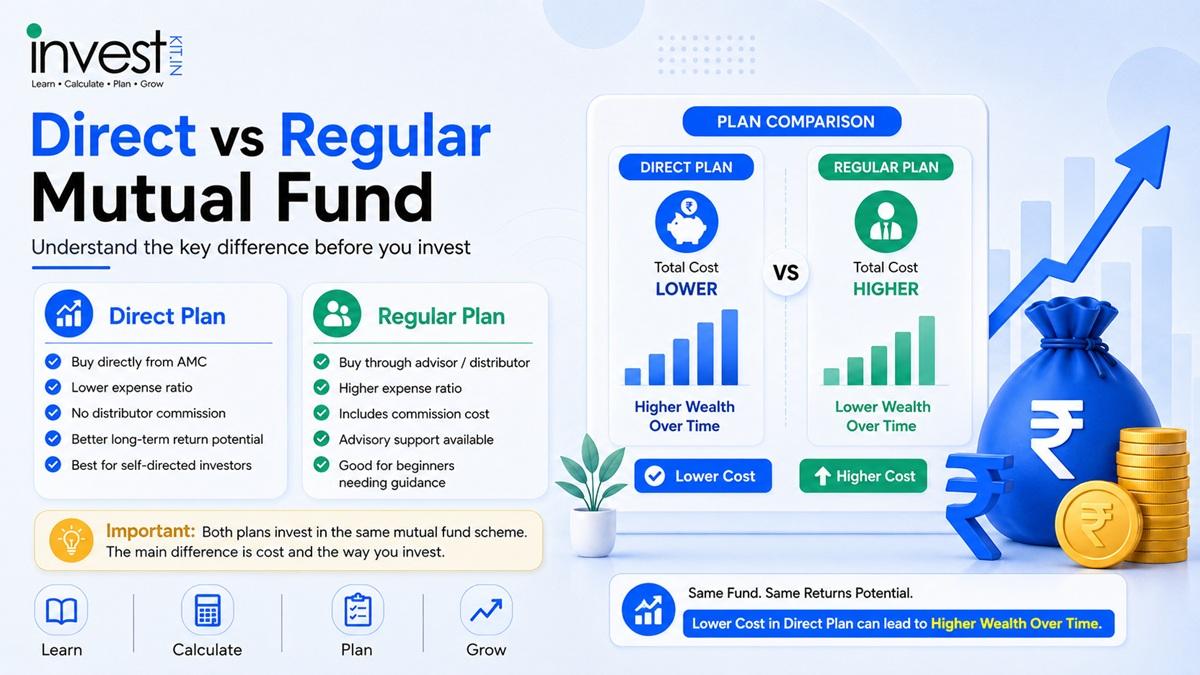
Direct vs Regular Mutual Fund — The Real Difference and Why It Always Matters
Picture this: two friends, Ananya and Rohan, both start investing ₹10,000 a month in the same mutual fund on the same day in 2010. Both stay invested for 15 years, never missing a SIP. Both experience the same market ups and downs. But by 2025, Ananya's portfolio is worth ₹63 lakh and Rohan's is ₹50 lakh. They invested identical amounts at the same time in the same fund. How is there a ₹13 lakh difference?
The answer is one word: direct. Ananya invested in the Direct Plan. Rohan invested in the Regular Plan. That single difference — which most investors in India either don't know about or haven't acted on — is responsible for a gap that would take Rohan years of extra SIP contributions to close.
The direct vs regular mutual fund debate is one of the most important financial decisions an Indian investor can make, and it's also one of the least discussed. In this guide, we'll break down exactly what these two plan types are, quantify the difference with real numbers, and show you how to switch if you're currently in regular plans.
What is a Direct Plan Mutual Fund?
When you buy a Direct Plan mutual fund, you purchase units directly from the Asset Management Company (AMC) — without any intermediary. No broker, no bank relationship manager, no distributor. You could buy it through the AMC's own website, through AMFI's MF Utilities platform, or through direct-plan investment platforms like Zerodha Coin, Kuvera, or Groww (when choosing the "direct" option).
Because there's no intermediary, there's no distribution commission to pay. The fund house doesn't need to build a distributor margin into the expense ratio. Result: the Total Expense Ratio (TER) of the Direct Plan is significantly lower than the Regular Plan.
Direct Plans were mandated by SEBI and launched in January 2013. Since then, their AUM has grown dramatically — according to AMFI data from early 2026, Direct Plans account for nearly 45–48% of total mutual fund industry AUM in India, reflecting growing investor awareness.
What is a Regular Plan Mutual Fund?
A Regular Plan mutual fund is the version you buy through a distributor — a broker, a bank's wealth management team, a financial advisor who earns commissions, or an investment platform that gets paid by the fund house. The distributor receives a commission for bringing in and (in theory) servicing your investment.
This commission — called "trail commission" — is paid by the AMC to the distributor, and the AMC recovers this cost by charging a higher TER on Regular Plans. You, the investor, pay for the distributor through a higher annual expense ratio — every single year you remain invested in that fund.
It's important to be fair here: some distributors provide genuine ongoing advice, portfolio reviews, and hand-holding through market volatility. If your distributor actively manages your portfolio and provides real financial planning value, a small TER premium may be worth it. But many investors are in regular plans through banks or platforms that provide zero ongoing service — essentially paying a permanent commission for a one-time transaction.
Direct vs Regular Mutual Fund — The Key Differences
| Factor | Direct Plan | Regular Plan |
|---|---|---|
| Expense Ratio (TER) | Lower (0.1%–1.5% depending on fund type) | Higher (0.5%–2.5% depending on fund type) |
| NAV | Higher (because lower fees mean NAV grows faster) | Lower (higher fees reduce NAV growth) |
| Returns | Higher (typically 0.5%–1.5% p.a. more) | Lower |
| Distributor Involved | No | Yes |
| Advice Provided | Self-directed (or fee-based advisor) | Distributor may provide advice |
| Where to Buy | AMC website, direct platforms | Banks, brokers, fund apps (regular mode) |
| Same Fund? | Yes — identical underlying portfolio | Yes — identical underlying portfolio |
The crucial point in the last row: Direct and Regular plans of the same fund invest in exactly the same stocks and bonds. The fund manager makes the same buy/sell decisions. The only difference is the fee — and therefore the NAV and ultimately your returns.
The Real Money Difference: Direct vs Regular Mutual Fund Returns
Let's stop being theoretical and look at actual historical numbers. Taking a popular large-cap index fund as an example, the NAV difference between its Direct and Regular plans compounds over time — the Direct plan NAV grows faster every single day because it incurs lower expenses.
Here's a hypothetical illustration with round numbers. Assume a fund earns 13% gross returns. The Regular plan charges 1.8% TER (net return: 11.2%) and the Direct plan charges 0.3% TER (net return: 12.7%):
| Monthly SIP | Period | Regular Plan Corpus | Direct Plan Corpus | Difference |
|---|---|---|---|---|
| ₹10,000 | 10 years | ~₹21.9 lakh | ~₹24.0 lakh | ~₹2.1 lakh |
| ₹10,000 | 15 years | ~₹49.7 lakh | ~₹57.0 lakh | ~₹7.3 lakh |
| ₹10,000 | 20 years | ~₹97.1 lakh | ~₹1.18 crore | ~₹21 lakh |
| ₹20,000 | 20 years | ~₹1.94 crore | ~₹2.36 crore | ~₹42 lakh |
The gap widens dramatically with time and investment amount. For someone investing ₹20,000/month for 20 years, the direct vs regular mutual fund difference could be ₹40+ lakh. That's a second car, a child's higher education, or a meaningful chunk of retirement funding — simply lost to unnecessary distributor fees.
You can calculate the exact impact for your own portfolio using our Expense Ratio Calculator.
Why Are Most People Still in Regular Plans?
In my experience looking at Indian investor portfolios, a large proportion of retail investors — especially those who started through banks, LIC agents, or traditional wealth management channels — are in Regular plans without realising there's a Direct alternative. The reasons are:
- Unawareness: They simply didn't know Direct plans existed. Banks and brokers have no incentive to tell you about Direct plans — it would eliminate their commission.
- Inertia: Even investors who know about Direct plans often haven't switched due to the perceived hassle of the process.
- Misunderstanding: Many investors think Regular plans offer some "extra service" or protection that Direct plans don't — they don't. The underlying fund is identical.
- Tax concern: Some investors worry that switching will trigger capital gains tax, making it not worthwhile. This concern is sometimes valid for large portfolios with big gains — worth calculating carefully.
How to Check If You're in a Direct or Regular Plan
It's easy to check. Look at your investment statement or platform portfolio page:
- If your fund name shows "(Direct)" or "Direct Plan" — you're in the right place.
- If it shows "(Regular)" or "Growth" without the word "Direct" — you're in the Regular Plan.
- Alternatively, download your Consolidated Account Statement (CAS) from NSDL (www.nsdl.co.in) or CDSL (www.cdslindia.com) — each fund entry will clearly mention the plan type.
How to Switch From Regular to Direct Mutual Fund Plan
If you discover you're in Regular plans, here's how to switch to Direct:
Method 1: Redeem and Re-invest
- Redeem your units from the Regular Plan
- Wait for the proceeds to arrive in your bank account (typically 2–5 business days for equity funds)
- Re-invest the proceeds in the Direct Plan of the same fund through the AMC's website or a direct platform
Important: This redemption is a taxable event. If you've held the units for more than 12 months, Long Term Capital Gains tax (12.5% on gains above ₹1.25 lakh/year) applies. Calculate whether the tax cost is worth the long-term savings before switching a large lump sum.
Method 2: Switch (Some Fund Houses)
Some AMCs allow a direct "switch" within the same fund — from Regular to Direct plan. This is still a taxable event (treated as redemption + reinvestment), but is simpler operationally. Check if your fund house offers this option on their website.
Method 3: Stop Regular SIPs, Start Direct SIPs
If switching triggers significant tax, the pragmatic approach is:
- Stop your Regular plan SIP (don't redeem existing units — let them sit and grow)
- Start a new SIP in the Direct Plan of the same fund from this month onwards
- Over time, as your Regular plan holdings age and the tax on switching reduces (or annual exemption absorbs the gains), redeem and move to Direct gradually
Which Platforms Are Best for Direct Plan Mutual Fund Investing in India?
Several excellent platforms allow you to invest in Direct plans with zero transaction fees:
- Kuvera: Completely free, direct plans only, clean UI, good for long-term investors. Also offers goal-based investing.
- Zerodha Coin: Direct plans, integrated with Zerodha demat. No commission, small annual account fee.
- ET Money (Pro): Offers direct plans with financial planning tools.
- Paytm Money: Direct plans available, zero commission model.
- AMC Websites Directly: Every fund house (HDFC AMC, Mirae Asset, Axis, SBI, etc.) allows direct investment on their website. Slightly less convenient if you have multiple funds across AMCs.
- MF Utilities (MFU): AMFI's own platform that allows direct investment across fund houses. Free and reliable.
When Might a Regular Plan Make Sense?
To be balanced: there are scenarios where a Regular plan can be justified.
- If you have a genuinely excellent fee-based financial advisor who actively manages your portfolio, rebalances, reviews annually, and provides real financial planning — and their value exceeds the extra TER you pay.
- If you're genuinely not confident in making investment decisions and need the hand-holding of a human advisor who can prevent you from panic-selling during a crash. The cost of preventing one emotional mistake may far exceed years of higher TER.
- Note: The key distinction is between a SEBI-registered Investment Advisor (RIA) — who charges a transparent fee and recommends Direct plans — and a distributor who earns trail commissions and has an incentive to keep you in Regular plans. If your advisor earns commission, they are a distributor, not an advisor, regardless of what they call themselves.
Direct vs Regular: The SIP Planning Angle
When planning long-term goals — whether it's retirement, a child's education, or buying a home — the extra returns from Direct plans can meaningfully reduce the SIP amount you need to achieve the same target. If you want to build ₹1 crore in 15 years, the required monthly SIP is lower in a Direct plan than in a Regular plan because of the compounding advantage of lower fees.
Use our SIP for 1 Crore Calculator and our SIP Goal Planner to model your goals with Direct plan return assumptions.
Conclusion: Direct vs Regular Mutual Fund — Always Choose Direct
When it comes to direct vs regular mutual fund plans, the conclusion is clear for self-directed investors: always choose Direct. The underlying fund is identical. The only difference is how much of your returns you keep. Over a 15–20 year SIP horizon, the direct plan advantage can compound into lakhs of rupees of additional wealth.
If you're currently in Regular plans, do a quick audit today. Check your CAS statement, understand what you're paying in extra TER, calculate the long-term cost, and make a conscious decision — either switch, start new SIPs in Direct, or continue in Regular with a full understanding of the cost.
Your mutual fund investments deserve to work as hard as possible for you. Don't leave lakhs on the table for a distributor who may never even call you again.
Disclaimer: This article is for educational purposes only and does not constitute financial advice. Return figures are illustrative and based on hypothetical scenarios. Actual returns will vary based on market performance and fund-specific factors. Please consult a SEBI-registered financial advisor or investment advisor before making investment decisions.
Frequently Asked Questions — Direct vs Regular Mutual Fund
Is the investment portfolio different in Direct vs Regular plans of the same fund?
No — the portfolio is exactly identical. The same fund manager makes the same investment decisions. The same stocks and bonds are held in both plans. The only difference is the expense ratio (TER), which results in a different NAV and therefore different returns over time.
Can I switch from a Regular plan to a Direct plan without tax?
No, switching from Regular to Direct is treated as a redemption and reinvestment by Indian tax laws, making it a taxable event. Long-term capital gains (held 12+ months) are taxed at 12.5% above ₹1.25 lakh/year; short-term gains are taxed at 20%. You should calculate whether the tax cost is offset by future savings in TER. For large portfolios with significant unrealised gains, a phased switch over 2–3 years may be more tax-efficient.
Are Direct plans available on all platforms?
Direct plans are available on direct-only platforms like Kuvera, Zerodha Coin, Paytm Money, ET Money Pro, and all AMC websites. Many aggregator apps and banks default to Regular plans — always verify the plan type before completing your investment.
Does investing in Direct plans mean I don't get any advice?
Correct — Direct plans have no built-in advisor. You are responsible for your own fund selection and portfolio decisions. If you want professional advice, consider engaging a SEBI-registered Investment Advisor (RIA) who charges a flat fee or a percentage-based fee and is legally obligated to act in your interest. This is different from a distributor who earns commission.
My bank FD agent suggested I invest through them in mutual funds. Should I?
If your bank agent is suggesting mutual funds, they will very likely be putting you in Regular plans — because that's how they earn commission. This isn't necessarily unethical, but you should be aware you're paying a higher TER. Ask them explicitly: "Is this a Direct plan or Regular plan?" If it's Regular, you can choose to invest through a direct platform instead. You can always get free financial education from resources like InvestKit and invest independently in Direct plans.
How much can I realistically save by switching to Direct plans?
It varies by fund type and investment amount, but as a rough guide: on a ₹10,000/month SIP over 20 years, switching from a 1.8% TER Regular plan to a 0.3% TER Direct plan (same gross return) could add ₹18–25 lakh to your final corpus. On ₹30,000/month over 20 years, the difference could be ₹55–75 lakh. The math always favors Direct — by a large margin over long periods.
Finance Disclaimer
This content is for educational purposes only and should not be considered financial advice. Please consult a certified financial advisor before making investment decisions.